


What if the bottleneck in your production environment isn’t your code, but the invisible layer of software sitting between your application and the hardware? It’s a common struggle for developers who need consistent throughput but find themselves fighting unpredictable latency. When you’re weighing vps vs dedicated server performance, you want the agility of the cloud without the “noisy neighbor” effect slowing down your database. We understand that reliability is everything when your reputation is on the line, and we’re here to act as your dedicated hosting partner.
This guide provides a technical deep dive into hardware-level allocation for 2026, helping you optimize your workloads with confidence. You’ll discover how the latest Intel Xeon 6+ and AMD EPYC 8005 architectures impact resource isolation and raw speed. With 26+ years of team experience, we’ve seen how the right hardware choice in our Rotterdam data centers can transform a struggling application into a high-speed success. We’re here to help you navigate the technical trade-offs between virtualized and bare metal environments so you can focus on building great things.
Key Takeaways
- Understand how hypervisor overhead affects resource distribution and why Pure Performance VPS is designed to minimize these latencies.
- Evaluate the technical shift from shared time-slices to dedicated physical cores using the latest AMD EPYC processor architecture for 2026.
- Compare vps vs dedicated server performance regarding NVMe storage throughput and random IOPS to eliminate disk-level bottlenecks.
- Identify when to scale into Enterprise Dedicated Servers for high-compliance workloads or stay with flexible virtualized environments.
- Learn how hosting in Rotterdam with offsite backups in Frankfurt ensures Dutch reliability and GDPR compliance for your production data.
Understanding the Performance Gap: Virtual vs. Physical Infrastructure
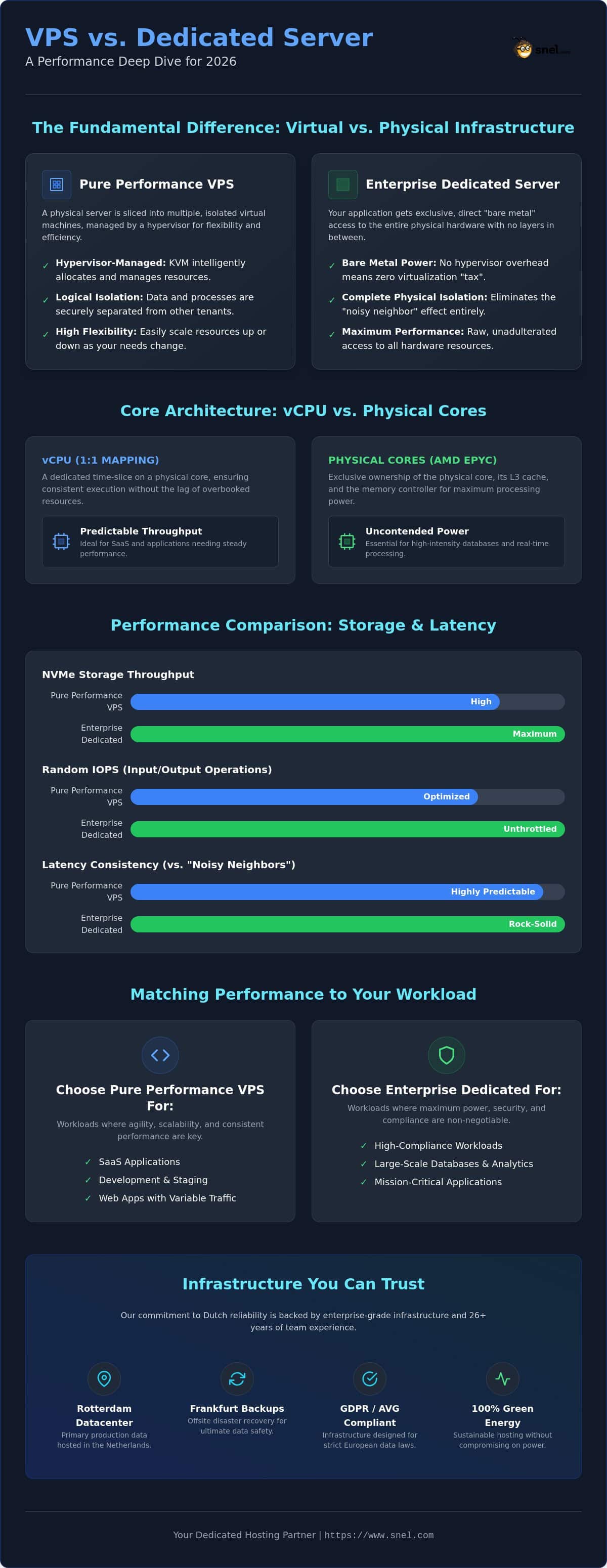
Virtualization acts as an abstraction layer between your software and the physical silicon. While it offers incredible flexibility, it traditionally introduces a small amount of latency known as virtualization overhead. This overhead comes from the hypervisor, the software responsible for slicing one physical machine into multiple virtual environments. When you look at vps vs dedicated server performance, the primary differentiator is how your application communicates with the CPU and memory.
In a virtualized setup, the hypervisor translates requests, which can lead to minor delays during high-intensity operations. However, recent advancements in hardware-assisted virtualization have reduced this “tax” significantly. Modern processors are now designed to handle these translations at the hardware level, making the gap between virtual and physical performance smaller than it has ever been. To better understand this concept, watch this helpful video:
The Role of the Hypervisor in Resource Management
KVM (Kernel-based Virtual Machine) is the backbone for most high-performance clouds in 2026. It manages CPU cycles by scheduling virtual tasks onto physical cores. Every time a VPS switches between tasks, a context switch occurs. If not managed properly, these switches add up, creating micro-stutters that impact real-time applications. At Snel.com, we use our 26+ years of team experience to tune these kernels. Our Pure Performance VPS is optimized to ensure that your vCPU allocation translates into steady, reliable throughput for your production workloads.
Resource Contention and the Noisy Neighbor Effect
Shared environments often suffer from noisy neighbors, where one tenant’s traffic spike steals resources from others. This is a major pain point for developers who need predictable latency. We solve this through strict resource isolation. While a VPS uses logical isolation to keep data separate, Enterprise Dedicated Servers offer total physical isolation. There’s no hypervisor, no shared cache, and no other tenants. You get raw, unadulterated access to the hardware in our Rotterdam facility. This setup is the gold standard for consistent, high-intensity database operations where even a millisecond of contention is unacceptable. For disaster recovery, we pair this Dutch reliability with offsite backups in Frankfurt, Germany, ensuring your data stays safe and accessible.
Core Architecture: vCPU Allocation and Physical Processor Power
The core of vps vs dedicated server performance lies in how the CPU handles your threads. While clock speed (GHz) often gets the most marketing attention, the real heavy lifting is done by Instructions Per Clock (IPC) and the size of the L3 cache. Silicon doesn’t lie. A processor with a higher IPC can perform more operations in a single cycle, which is why a modern AMD EPYC chip often outperforms older hardware even at lower frequencies. We see this daily in our Rotterdam data centers, where architectural efficiency beats raw speed every time.
Shared vs. Dedicated vCPUs in VPS Environments
In a standard virtual environment, a vCPU is essentially a scheduled time slice on a physical core. This means your application might wait a few microseconds for its turn if other tenants are active. Our Pure Performance VPS changes this by using a 1:1 vCPU mapping. This setup is perfect for SaaS builders and developers who need consistent execution without the lag of overbooked resources. vCPU scheduling determines the precision with which your application executes time-sensitive tasks.
Raw Bare Metal Power of AMD EPYC Dedicated Servers
When you step up to Enterprise Dedicated Servers, you aren’t just buying cores. You’re buying the entire L3 cache and memory controller. In a virtualized environment, that cache is shared among multiple tenants, which can lead to cache misses and slower processing. On bare metal, your application has exclusive access to the massive L3 cache found in the AMD EPYC 8005 series, which launched in May 2026. This architecture is a game changer for multi-threaded workloads and large-scale databases that demand zero interference.
Memory bandwidth is another critical factor where physical hardware shines. Dedicated hardware provides direct access to ECC (Error Correction Code) memory channels. This prevents data corruption and ensures stability for enterprise workloads that run 24/7 without the slight overhead of virtual memory management. If you’re unsure which architecture fits your specific database needs, our team can help you compare hardware configurations. We’ve spent 26+ years learning these technical nuances to ensure your production environment stays fast and reliable.
Storage and Network Throughput: Beyond Raw CPU Speed
Storage is often the silent killer of application speed. While CPU cycles are vital, your data needs a fast lane to reach its destination. We standardize on Dell Enterprise hardware across our Rotterdam infrastructure to ensure every byte moves with precision. When you evaluate vps vs dedicated server performance, the storage architecture is just as critical as the processor itself. A bottlenecked disk can make the fastest CPU wait for data, wasting expensive resources.
NVMe Performance in Virtualized vs. Native Systems
NVMe storage can achieve sub-200µs latency and 30,000 to 40,000 random IOPS, which is a massive leap over traditional SATA SSDs. In a virtualized system, your VPS typically connects to a high-speed distributed storage network. This setup allows for instant scalability and high availability. Conversely, an Enterprise Dedicated Server utilizes direct-attached NVMe drives. This removes the network hop entirely and provides the absolute lowest latency possible for high-frequency trading or large database queries.
We protect this performance with AES-256 encryption and daily backups via Acronis Cyber Protect. While backups are essential, they can consume significant I/O. We optimize our backup windows to minimize impact on your production environment. Your live data remains in the Netherlands, while we keep your disaster recovery copies safe in Frankfurt, Germany. This geographical separation is a key part of our Dutch reliability commitment, ensuring your business stays online even in extreme scenarios.
Network Latency and 100 Gbps Connectivity
Raw disk speed is only useful if the network can carry the load without dropping packets. Our Rotterdam datacenter features a 100 Gbps capacity with 60+ points of presence globally. This ensures that your users experience crisp response times whether they’re in Amsterdam or London. We monitor this infrastructure 24/7 to catch and resolve potential bottlenecks before they affect your traffic. Our 26+ years of team experience has taught us that network consistency is the foundation of a reliable host.
Structural reliability is just as important as network uptime; the physical protection of industrial facilities often involves specialized roofing and maintenance from experts like Fladderak Dakbeheer to ensure the environment remains secure for mission-critical hardware.
For internal communication between your database and web server, we recommend using a Private Network. This keeps your backend traffic off the public internet, which reduces latency and significantly increases security. It’s a simple way to boost your overall vps vs dedicated server performance metrics without upgrading your core hardware. If you’re ready to design a network that scales with your growth, chat with our technical team today for a personalized assessment.
Strategic Selection: Matching Performance to Your Production Workload
Choosing between these two paths depends on your specific growth trajectory and technical requirements. While we’ve analyzed the technical vps vs dedicated server performance metrics, the final decision often comes down to how your team manages infrastructure. Our Rotterdam-based experts see many SaaS builders start with virtualized environments to maintain agility. This approach lets you focus on development while we handle the underlying hardware. We’re here to act as your partner, ensuring you have the right resources at every stage of your journey.
When to Scale with Pure Performance VPS
There’s a specific point where modular scaling becomes more efficient than a full hardware overhaul. If your traffic fluctuates seasonally, the ability to add RAM or vCPU on a “monthly cancellable” basis prevents you from paying for idle resources. This flexibility is vital for startups that need to pivot quickly without being locked into a rigid hardware configuration. For teams that lack the time for 24/7 administration, a Managed VPS provides a hands-off experience. We take care of the security updates and monitoring, so you can stay focused on your core business goals.
When Enterprise Dedicated Servers are Essential
Big data processing and high-compliance workloads often make bare metal a non-negotiable requirement. When your production environment demands the absolute physical isolation of an ISO 27001 certified facility, Enterprise Dedicated Servers are the only answer. You aren’t just getting raw power; you’re getting a dedicated hardware environment that meets strict GDPR and AVG adherence standards. This level of isolation is crucial for financial services or healthcare applications where data privacy is paramount.
Hosting in Rotterdam ensures your data stays under Dutch jurisdiction, providing a level of legal security that impersonal global providers can’t match. We pair this with offsite backups in Frankfurt, Germany, to guarantee your disaster recovery plan is robust. With 26+ years of team experience, we act as an involved partner rather than a distant utility. Whether you choose a scalable virtual path or the raw strength of bare metal, our team is always ready to assist with technical validation and long-term strategy.
Optimize Your Workload for Maximum Throughput
Navigating the technical nuances of vps vs dedicated server performance ensures your application remains responsive as user demands grow. By aligning your architecture with the right hardware-level allocation, you eliminate the risks of resource contention and unpredictable latency. Whether you prioritize the agile scalability of a virtualized environment or the unadulterated power of bare metal, your choice should support a stable and secure production path.
Our team brings 26+ years of expertise to every deployment. We operate from an ISO 27001 certified, 100% green energy datacenter in Rotterdam, providing the Dutch reliability your business deserves. We’re more than just a provider; we’re a dedicated partner ready to help you validate your technical strategy and scale with confidence. If you’re ready to find the perfect fit for your next project, get in touch with our experts today. We’ve got your back every step of the way.
Frequently Asked Questions
Is a VPS always slower than a dedicated server for database tasks?
A VPS isn’t always slower for small to mid-sized database operations, especially when using Pure Performance VPS with dedicated vCPU mapping. However, for large-scale production databases, a dedicated server provides superior performance by eliminating hypervisor overhead and resource contention. Bare metal ensures that 100% of the hardware resources are available for your queries, whereas a VPS relies on a shared physical host that manages multiple tenants.
How does dedicated vCPU allocation in a VPS compare to bare metal cores?
Dedicated vCPU allocation provides a 1:1 ratio with physical threads, which significantly improves consistency compared to standard shared instances. While this narrows the gap in vps vs dedicated server performance, bare metal cores still offer direct access to the CPU’s L3 cache and instruction sets. This lack of a virtualization layer allows for lower latency in high-compute tasks that require constant, uninterrupted processor availability for real-time processing.
What is the performance impact of hosting data in a green Rotterdam datacenter?
Hosting in our Rotterdam facility ensures sub-10ms latency for most users in the Benelux region and Western Europe. We use 100% green energy to power our Dell Enterprise hardware, proving that sustainability doesn’t come at the cost of speed. This strategic location in the Netherlands provides a high-density network environment with direct connections to major internet exchanges, ensuring your production workloads remain fast and reliable for a global audience.
Can I upgrade from a VPS to a dedicated server without significant downtime?
Upgrading from a VPS to a dedicated server typically requires a migration process, but downtime can be minimized with proper planning. We recommend using a staging environment to sync data before the final switch. Our team of experts, with 26+ years of experience, can assist in coordinating this transition to ensure your services remain available. Since both environments use our Rotterdam infrastructure, internal data transfer speeds are exceptionally fast during the move.
Does the hypervisor layer significantly increase network latency?
Modern hypervisors like KVM add only a few microseconds of latency, which is unnoticeable for standard web applications and SaaS platforms. The impact only becomes significant in high-frequency trading or real-time gaming environments where every microsecond counts. In those specific cases, the native network stack of a dedicated server is preferable. For most builders, the flexibility of a VPS outweighs the minimal latency introduced by the virtualization layer.
How does NVMe storage performance differ between virtual and physical environments?
In a VPS environment, NVMe storage is often part of a distributed network that provides high availability and easy scaling. A dedicated server uses direct-attached NVMe drives, which removes the network layer entirely for maximum IOPS. While a VPS offers excellent throughput for most applications, a dedicated server is the better choice for data-heavy tasks that require the absolute lowest disk latency and highest sustained read/write speeds.