


Did you know that attacks by AI-enabled adversaries surged by 89% in 2025? It’s a sobering reality for any server administrator. We know that keeping your data safe often feels like a race against an invisible clock. You want a setup that’s rock-solid, but the complexity of modern threats can be overwhelming. It’s natural to worry about data breaches and the time it takes to manage security updates. You deserve a stable environment that respects your time and protects your reputation.
This guide provides a clear path to total protection. You’ll learn the specific steps for Plesk VPS security hardening using the latest Plesk Obsidian 18.0.81 features and infrastructure-level protocols. We’ll explore how to use our ISO 27001:2022 certified infrastructure in Rotterdam to block unauthorized access and prevent data loss. From OS-level tweaks to advanced firewall settings, we’re covering the essential layers that ensure your VPS meets strict GDPR standards while giving you back your peace of mind.
Key Takeaways
- Learn how to implement a layered Plesk VPS security hardening strategy to proactively defend against automated credential stuffing and evolving brute-force threats.
- Discover how to safeguard your administrative panel by enabling Multi-Factor Authentication and utilizing the Plesk Advisor for real-time security monitoring.
- Master essential OS-level techniques, such as disabling root SSH logins and configuring Fail2Ban, to automatically block malicious actors from your server.
- Ensure long-term stability by hosting your data in an ISO 27001 certified Rotterdam facility with AES-256 encrypted backups for disaster recovery.
The 2026 Threat Environment for VPS Infrastructure
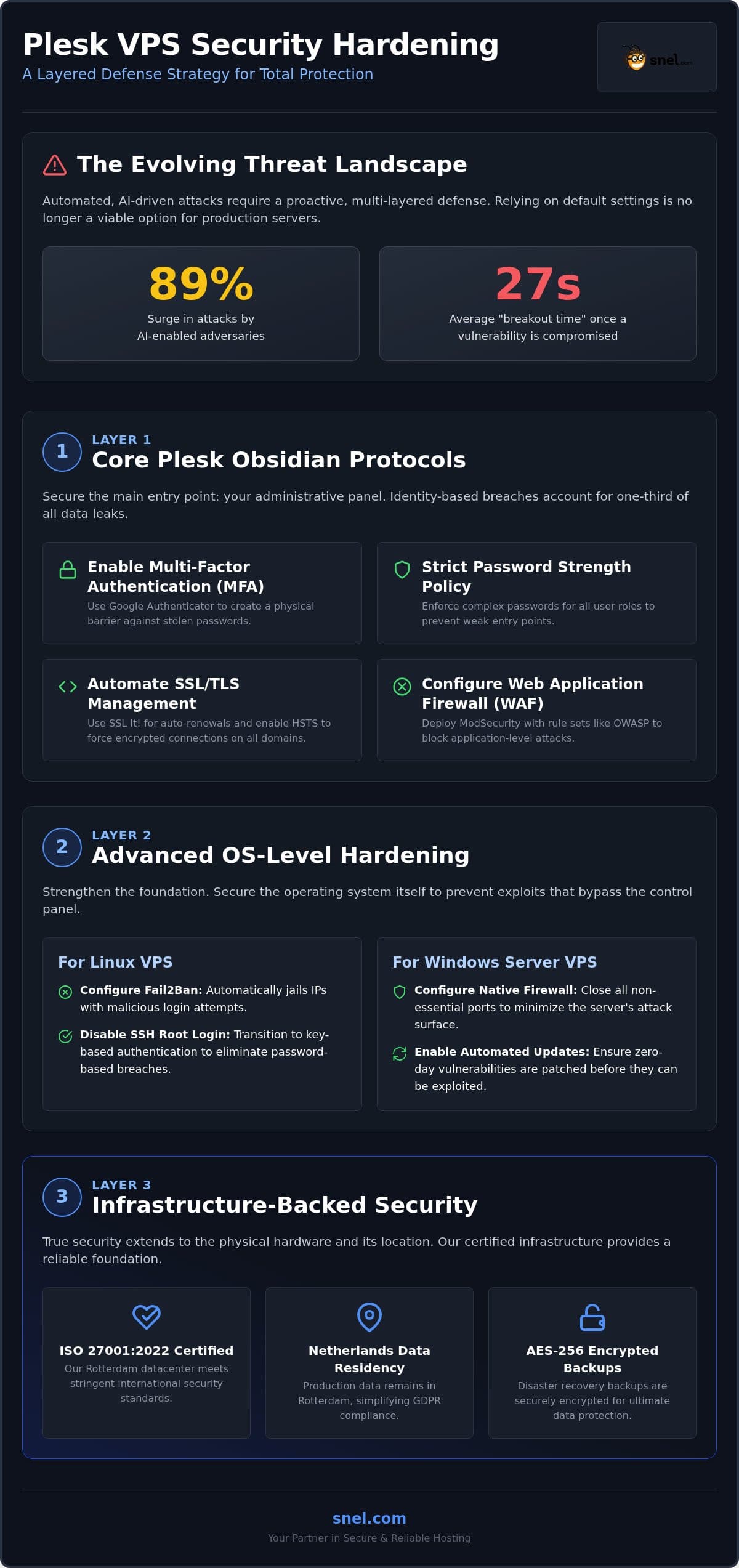
Attackers don’t sleep, and in 2026, they’ve traded manual scripts for AI-driven botnets. These automated systems execute credential stuffing and brute-force attempts at speeds that were impossible just a few years ago. Recent industry data shows that the average “breakout time” has dropped to just 27 seconds. This means that once a vulnerability is found, lateral movement happens almost instantly. You need a defense that reacts faster than a human can.
Relying on a standard installation is a gamble. While Plesk is secure out of the box, it’s configured for maximum compatibility rather than maximum defense. Immediate Plesk VPS security hardening is necessary to close common entry points. A “set and forget” approach for production workloads often leads to disaster, as attackers now weaponize legitimate tools to conduct reconnaissance. It’s vital to distinguish between application-level vulnerabilities, like an XSS flaw in a CMS, and server-level exploits that target the underlying OS or panel.
Defining the Zero-Trust Model for Servers
Security starts with the principle of least privilege. Every administrative account should only have the exact permissions required for its task. We recommend restricting administrative access to specific IP ranges. This ensures that even if credentials are stolen, the attacker cannot log in from an unauthorized location. It’s a simple, proactive step that drastically reduces your attack surface without adding unnecessary complexity to your daily workflow.
The Role of Data Residency in Security
Location matters for more than just latency. Hosting your data in our Rotterdam datacenter simplifies GDPR compliance because your production data stays within the Netherlands. As an ISO 27001:2022 certified provider, we own our physical hardware. This gives us total control over the infrastructure layer, unlike impersonal providers who rent space from third-party clouds. For those without a dedicated IT team, our Managed VPS options provide an expert partner to handle these infrastructure-level protocols for you.
Core Plesk Obsidian Security Protocols
Securing the panel is your first line of defense. Identity-based breaches now account for one-third of all data leaks, making access control vital. Start your Plesk VPS security hardening by enabling Multi-Factor Authentication (MFA). The Google Authenticator extension is a reliable choice. It creates a physical barrier that stolen passwords alone cannot cross, ensuring only authorized users reach the dashboard.
Don’t overlook the basics. Implement a strict Password Strength Policy for every user role. This prevents weak entries from compromising your environment. For technical oversight, use the Plesk Advisor. It provides a real-time security score and a prioritized checklist to fix vulnerabilities. If you use the XML API for integrations, restrict access to specific, authorized IPs only to block external interference.
Automated SSL/TLS Management
Encryption is non-negotiable for modern trust. Use the SSL It! extension to automate Let’s Encrypt certificate renewals. This ensures your sites never show “Not Secure” warnings to visitors. Enable HSTS to force encrypted connections across all hosted domains. Remember to secure your mail server too. Valid SSL/TLS certificates for IMAP, POP3, and SMTP prevent credential sniffing during email logins.
Web Application Firewall (WAF) Configuration
ModSecurity is your shield against application-level attacks. Select rule sets tailored to your specific stack, such as the OWASP Core Rule Set for custom apps or specialized rules for WordPress. Monitor your WAF logs regularly to identify and block persistent attackers before they find a way in. If these configurations feel daunting, you can always reach out to our support team for guidance on best practices.
Advanced OS-Level Hardening for Linux and Windows
Hardening the operating system requires different tools depending on your specific stack. For Linux users, Fail2Ban is your best friend. It monitors system logs and automatically jails IP addresses that exhibit malicious behavior, such as repeated failed login attempts. You should also disable root login for SSH. Transitioning to key-based authentication removes the risk of password-based breaches entirely. It’s a simple change that makes your server significantly harder to crack. For those on a Windows Server VPS, the native firewall is your primary shield. Ensure it’s configured to close all non-essential ports to minimize your attack surface. Automated system updates are vital for both platforms. They patch zero-day vulnerabilities before attackers can exploit them. This proactive approach is a cornerstone of effective Plesk VPS security hardening.
Hardening Connections with DANE
Protecting your connections from sophisticated man-in-the-middle attacks requires modern protocols like DANE. Start by generating a public key hash for your SSL/TLS certificates. You can then add TLSA DNS records to your domain’s DNS zone to verify the certificate’s authenticity. This is especially effective for securing mail server connections. It ensures that encrypted traffic isn’t intercepted or redirected by a malicious third party. Implementing DANE adds a vital layer of trust to your infrastructure that standard SSL alone cannot provide.
Database and PHP Security
Application security relies on a clean, updated environment. You should immediately disable outdated PHP versions that no longer receive official security patches. Running legacy code on your server is an open invitation for exploits. Additionally, always restrict database access to localhost or specific private network segments. This prevents external actors from even attempting to connect to your data layer. By isolating your databases, you ensure that even a compromised web application doesn’t lead to a total data breach.
Infrastructure-Backed Security with Snel.com
Software settings are only half the battle. True Plesk VPS security hardening requires a foundation built on certified hardware. Our infrastructure in Rotterdam is ISO 27001:2022 certified, ensuring that your data residency remains strictly Dutch. We own the physical hardware, which allows us to maintain a PUE below 1.15. This provides a level of physical security and environmental efficiency that software-only providers simply cannot match. You can scale your resources modularly, ensuring stability during sudden traffic spikes without compromising your hardened security posture.
Managed vs. Unmanaged Hardening
Choosing between unmanaged and Managed VPS depends on your internal expertise. On unmanaged systems, you are responsible for OS-level patching, panel updates, and ongoing firewall maintenance. It’s a significant time investment. Our managed services provide a hands-off approach to infrastructure administration. We act as your dedicated partner, handling the technical heavy lifting and 24/7 monitoring so you can focus on building your SaaS or managing your clients.
Disaster Recovery and Business Continuity
Reliability means planning for the unthinkable. We utilize Acronis Cyber Protect with AES-256 encryption to safeguard your information. While your production data stays in Rotterdam, we maintain offsite backups in Frankfurt strictly for disaster recovery. This geographical separation is a key part of a robust business continuity plan. Combined with our proactive hardware monitoring, we aim for 100% uptime by catching potential issues before they impact your service. This complete approach ensures your Plesk VPS security hardening efforts aren’t undermined by hardware failures or regional disasters.
Future-Proof Your Server Environment
Securing your infrastructure requires constant vigilance. By implementing layered defenses like Multi-Factor Authentication and OS-level jails, you significantly reduce the risk of identity-based breaches. True Plesk VPS security hardening combines these panel settings with a stable foundation. Using our ISO 27001 Certified Datacenter in Rotterdam ensures your production data stays protected under strict Dutch residency laws. We’re proud to offer 100% Green Energy Dutch hosting that doesn’t compromise on power or reliability.
Whether you choose to manage these protocols yourself or partner with our 24/7 in-house expert support for a managed approach, the goal is peace of mind. You focus on your code and your customers; we’ll handle the stability of the underlying hardware. Our team is always ready to assist you in building a resilient environment that meets GDPR standards and exceeds performance expectations.
Let’s work together to make your infrastructure unshakeable.
Plesk Security: Frequently Asked Questions
Is Plesk Obsidian secure by default?
Plesk Obsidian 18.0.81 is secure for general use, but it prioritizes compatibility over strict lockdowns. For production servers, you must disable unused services and close open ports manually. A standard install doesn’t include Multi-Factor Authentication by default. Enabling these extra layers ensures that your administrative interface isn’t just protected by a password, but by a robust second layer of verification.
What is the most common security mistake on a Plesk VPS?
The most frequent error is using weak passwords for mail accounts and administrative users. Many administrators also forget to restrict SSH access, leaving the door open for automated botnets. Since identity-based attacks are rising, failing to implement IP-based restrictions for the Plesk XML API is another significant risk. These simple oversights often lead to compromised credentials and unauthorized data access.
How does Fail2Ban protect my server from brute-force attacks?
Fail2Ban works by monitoring your server’s log files for patterns that indicate an attack. When it detects multiple failed login attempts from a single IP, it creates a jail and blocks that address at the firewall level. This is a critical component of Plesk VPS security hardening because it stops automated brute-force tools before they can guess your credentials or exhaust your server’s resources.
Do I need a dedicated firewall if I use Plesk?
While Plesk includes a built-in firewall, a dedicated network firewall adds a vital layer of protection. This is a critical part of a thorough Plesk VPS security hardening strategy. Network-level firewalls block malicious traffic before it ever reaches your server’s network interface. This reduces the load on your VPS and prevents attackers from probing for OS vulnerabilities in our Rotterdam datacenter.
Can I automate security updates in Plesk?
You can easily automate both Plesk and system-level updates through the Tools and Settings menu. Enabling this ensures that critical security patches are applied as soon as they’re released, protecting you from zero-day exploits. If you’re using our Managed VPS service, our team handles these updates for you. We monitor the environment 24/7 to ensure your applications remain stable and secure.