


The stable, “set-it-and-forget-it” era of the traditional CentOS VPS is officially a memory. You likely relied on that rock-solid predictability for years to keep your applications running without surprises. Now, the shift toward the “rolling” nature of CentOS Stream might feel like a gamble with your production environment. It’s a common worry; nobody wants to risk breaking a live system or getting stuck with an impersonal cloud giant that doesn’t answer the phone.
We understand that your priority is uptime and performance, not constant troubleshooting. This guide helps you regain that sense of security. You’ll discover how to maintain enterprise-grade stability on high-performance Dutch infrastructure while the Linux ecosystem continues to evolve. We’ll break down the practical differences between CentOS Stream and its popular successors like AlmaLinux. We also look at how a dedicated partner utilizing our robust datacenter infrastructure can simplify your migration. By the end, you’ll have a clear plan to keep your servers fast, secure, and compliant.
Key Takeaways
- Understand how a CentOS VPS in 2026 functions as an upstream development platform and how to manage the shift from legacy CentOS versions.
- Learn to choose the right path for your workload by comparing the agility of CentOS Stream with the production-ready stability of AlmaLinux and Rocky Linux.
- Identify the hardware essentials, including AMD EPYC processors and NVMe storage, required to maintain high performance on modern Linux distributions.
- Discover how personal support from a local Rotterdam-based partner helps you avoid vendor lock-in while meeting strict GDPR and ISO 27001 standards.
The State of CentOS VPS in 2026: Understanding the Transition
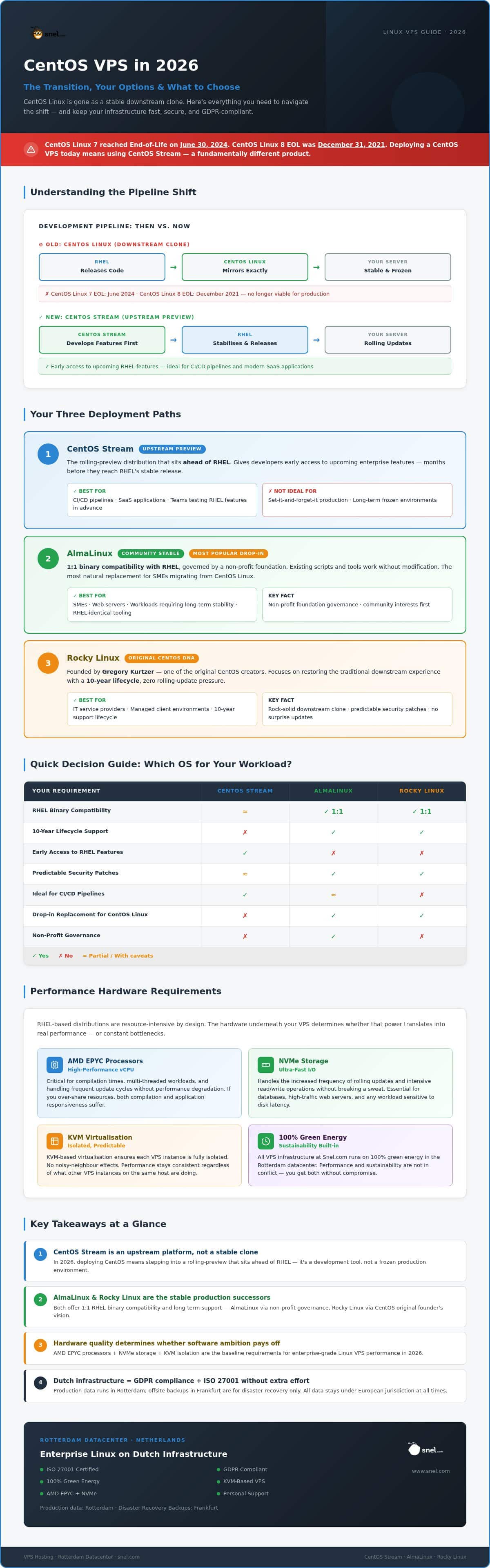
In 2026, deploying a CentOS VPS means stepping into the world of CentOS Stream. This platform is fundamentally different from the legacy CentOS Linux 7 and 8 that many IT professionals grew up with. Those older versions were “downstream” clones, meaning they followed Red Hat Enterprise Linux (RHEL) exactly. Today, CentOS Stream serves as the upstream development hub. It’s where the next version of RHEL is built. This shift changed the hosting framework for millions, moving from a static, frozen environment to a more agile, mid-stream distribution that powers modern web applications.
At Snel.com, we provide the stability this “moving” distribution demands. While the software is more dynamic, your hardware shouldn’t be a variable. We host all our VPS Hosting solutions in our own Rotterdam datacenter, using 100% green energy. Our infrastructure relies on AMD EPYC processors and NVMe storage to handle the increased frequency of updates without breaking a sweat. We pair this technical power with personal service, ensuring you have a dedicated ally to help navigate these technical shifts.
CentOS Stream vs. The Legacy CentOS Linux
The core difference lies in where the OS sits in the development pipeline. Legacy CentOS waited for RHEL to release code before mirroring it. CentOS Stream sits ahead of RHEL, acting as a preview of what’s coming next. Many developers prefer this early access because it allows them to test applications against upcoming RHEL features months in advance. It removes the guesswork from future compatibility. Choosing a CentOS VPS in this modern era provides the agility needed for continuous integration.
CentOS Stream’s release model is a rolling-preview for enterprise-grade software. By using this model, you benefit from continuous updates and security patches that keep your environment secure while maintaining a clear path toward RHEL-level reliability. This setup allows for continuous delivery without the jarring version jumps that used to break production environments during major migrations.
Choosing Your Path: CentOS Stream vs. Enterprise Successors
You have three main paths for your next CentOS VPS deployment. If you’re building modern SaaS applications or managing complex CI/CD pipelines, CentOS Stream is a powerful choice. It keeps you ahead of the RHEL curve. However, if your production workload requires the “set-it-and-forget-it” stability of the past, you should look at the successors. We’ve seen many clients struggle with this choice, but it’s simpler than it looks once you define your goals. Whether you choose Stream or a clone, our virtualization layer at Snel.com ensures seamless performance with KVM-based technology in our Rotterdam datacenter.
AlmaLinux: The Community-Driven Stable Choice
AlmaLinux has emerged as the most natural “drop-in” replacement for many SMEs. It offers 1:1 binary compatibility with RHEL and is governed by a non-profit foundation. This structure ensures that the community’s interests and long-term stability always come first. Many of our users find that their existing scripts and tools work without any modification. You can dive deeper into the technical comparisons in our guide on AlmaLinux VPS: The Enterprise-Grade CentOS Successor Compared. It’s an excellent choice for web servers where reliability is your primary metric.
Rocky Linux: Built by the Original CentOS Founder
Rocky Linux carries significant technical weight because it was founded by Gregory Kurtzer, one of the original creators of CentOS. It focuses heavily on restoring the traditional “downstream” experience. Our internal performance benchmarks on AMD EPYC hardware show remarkable consistency across all RHEL-based clones. Rocky Linux provides that familiar, rock-solid environment that many IT service providers demand for their clients. It’s built for those who want a ten-year lifecycle without the pressure of rolling updates.
Prioritize CentOS Stream when your developers need early access to upcoming enterprise features. Shift to AlmaLinux or Rocky Linux when you value long-term support and predictable security patches for live production systems. If you’re still weighing your options for a specific project, feel free to reach out to our team for a friendly chat about your infrastructure.
Performance Requirements for Enterprise-Grade Linux Hosting
RHEL-based distributions like CentOS Stream or AlmaLinux are designed for enterprise stability, but they’re resource-intensive. To get the most out of your CentOS VPS, you need hardware that matches the software’s ambition. High-performance vCPU allocation is critical here. If you share resources with too many other users, your compilation times and application response rates will suffer. Modern Linux environments thrive when they have enough breathing room to handle sudden traffic spikes without throttling.
Our Pure Performance VPS is built specifically to solve these bottlenecks. It provides strict resource isolation, ensuring that your CPU cycles are yours alone. When you’re dealing with database-heavy workloads, NVMe storage is a game-changer. It offers significantly higher IOPS than traditional SSDs, which means your database queries and file operations happen almost instantly. This hardware foundation is what allows a CentOS VPS to remain responsive under heavy production loads.
AMD EPYC and the Linux Kernel
Modern Linux kernels are optimized to leverage the high core counts found in AMD EPYC processors. These chips excel at parallel processing, making them ideal for multi-threaded applications and containerized environments. Snel.com uses dedicated vCPU to ensure consistent performance for enterprise workloads. This setup prevents “noisy neighbor” issues and gives you predictable power for every task.
Network Latency and European Data Residency
Hosting in our Rotterdam-based datacenter provides a massive advantage for European user bases. Lower latency means snappier applications and a better experience for your customers. Additionally, keeping production data strictly within the Netherlands ensures full GDPR compliance. You don’t have to worry about the Cloud Act or your data moving through secondary locations; it stays exactly where you put it.
As your application grows, your infrastructure should too. We offer independent upgrades for RAM and storage, so you don’t have to migrate to a larger plan just because you need a bit more disk space. This flexibility is key for SaaS builders who need to scale efficiently while keeping costs under control.
Why Snel.com is the Ideal Partner for Your Linux Infrastructure
Choosing a CentOS VPS isn’t just about selecting a software image; it’s about who stands behind your hardware. Large, impersonal cloud providers often treat you like a ticket number in an automated queue. We take a different approach. At Snel.com, you get direct access to in-house experts who actually understand the nuances of the Linux ecosystem. We’re a close-knit team based in Rotterdam. We’re passionate about helping you succeed. This personal connection ensures you’re never left guessing when the ecosystem shifts or technical challenges arise.
Our commitment to your business extends to our infrastructure’s environmental footprint. We operate on 100% green energy with a Power Usage Effectiveness (PUE) below 1.15. This level of efficiency reflects the precision we apply to every server we host in our Rotterdam datacenter. To keep your operations secure, we maintain ISO 27001 certification and include robust DDoS protection as a standard feature. You won’t find any restrictive vendor lock-in here. Our monthly cancellable plans give you the absolute freedom to scale or pivot whenever your business needs change.
Managed vs. Self-Managed CentOS Environments
Deciding between a self-managed setup or a Managed VPS depends entirely on your team’s technical bandwidth. If you prefer a hands-off approach, our managed services include 24/7 monitoring. We proactively handle critical security patches for your CentOS VPS to keep your environment resilient. It’s about giving you total peace of mind while our team handles the heavy lifting of server maintenance and optimization. Contact our experts today if you need help choosing the right distribution for your project.
Building a Resilient Infrastructure in a Changing Ecosystem
The evolution of the CentOS ecosystem doesn’t have to be a source of stress for your business. By understanding the shift toward CentOS Stream and the strengths of successors like AlmaLinux, you can make an informed decision that aligns with your technical needs. Whether you prioritize the agility of upstream development or the rock-solid stability of a traditional clone, your CentOS VPS deserves a home that offers uncompromising performance and local expertise.
We provide that reliable foundation through our ISO 27001 certified infrastructure and direct ownership of our Rotterdam-based datacenter. Our 4.8/5 Google review average reflects our commitment to being a dedicated partner rather than a distant utility. We’re here to help you navigate these technical changes with the transparency and personal touch you need to succeed in a competitive landscape.
We look forward to helping you build a faster, more secure future for your applications.
Frequently Asked Questions
Is CentOS still available for new VPS installations in 2026?
Yes, you can still deploy a CentOS VPS in 2026, but the version available is CentOS Stream. The legacy CentOS Linux versions, such as 7 and 8, reached their end-of-life years ago and are no longer receiving official security updates. CentOS Stream 9 and its successors remain active choices for developers who want a modern, RHEL-aligned environment on our high-performance Dutch infrastructure.
What is the difference between CentOS Stream and the old CentOS Linux?
The main difference is the development position. Old CentOS Linux was a downstream clone that copied RHEL exactly after its release. CentOS Stream is upstream, meaning it receives updates before they reach RHEL. This makes Stream more agile and better for testing upcoming features. While it’s still very stable, it follows a rolling-preview model rather than the static, long-term release cycle of the legacy versions.
Can I migrate from CentOS 7 to CentOS Stream without data loss?
You can’t safely perform an in-place migration from CentOS 7 directly to CentOS Stream without significant risk to your data. The architectural differences are too large for a simple update command. We always recommend a side-by-side migration. Set up a new instance on our Rotterdam-based hardware, move your data and configurations manually, and test everything thoroughly before decommissioning your old server to ensure zero downtime.
Which is better for a production server: AlmaLinux or CentOS Stream?
AlmaLinux is generally better for production servers where you need long-term stability and 1:1 binary compatibility with RHEL. It mimics the traditional CentOS experience perfectly. CentOS Stream is better suited for development environments or CI/CD pipelines where early access to new kernel features is a priority. For most SMEs and SaaS providers in the Netherlands, AlmaLinux provides the predictable security lifecycle they require.
Does Snel.com offer support for CentOS Stream configuration?
Yes, our in-house experts are ready to assist you. If you choose a Managed VPS, our team handles the monitoring and security patching of your CentOS VPS environment for you. For self-managed users, we provide a reliable virtualization layer and can answer technical questions about your distribution choice. We pride ourselves on being a dedicated partner, not just a provider, ensuring your Dutch hosting experience is smooth.