


What if your server’s operating system wasn’t just a placeholder, but a reliable partner that guaranteed you’d never face another CentOS-style disruption? You likely remember the scramble when the industry’s favorite stable OS shifted its model. It’s a valid fear. Nobody wants to deal with sudden EOL dates or delayed security patches when their business depends on stability. Choosing an AlmaLinux VPS means stepping into a 1:1 RHEL-compatible environment built for longevity.
In this guide, we explore why this distribution is the preferred choice for performance-critical workloads and how it stacks up against other Linux options. We’ll look at the technical synergy between the latest software releases and high-end hardware like AMD EPYC processors. From transparent specs in our cutting-edge datacenters to personal support from experts who actually know your name, we’ve got you covered. This article previews the stability and speed you can expect when you move away from impersonal cloud giants and choose a dedicated hosting partner.
Key Takeaways
- Learn why AlmaLinux provides a seamless transition for CentOS users through its 1:1 binary compatibility with Red Hat Enterprise Linux.
- Compare package management and stability cycles between AlmaLinux, Debian, and Ubuntu to find the perfect balance for your specific application.
- Understand how an AlmaLinux VPS leverages AMD EPYC processors and NVMe storage to handle demanding, multi-threaded enterprise workloads.
- Discover the value of choosing a personal hosting partner that offers expert support over the impersonal, automated systems of global cloud giants.
- Gain insights into how Rotterdam-based hosting and ISO 27001 certification protect your data with Dutch reliability and full GDPR compliance.
Why AlmaLinux VPS became the standard for enterprise stability
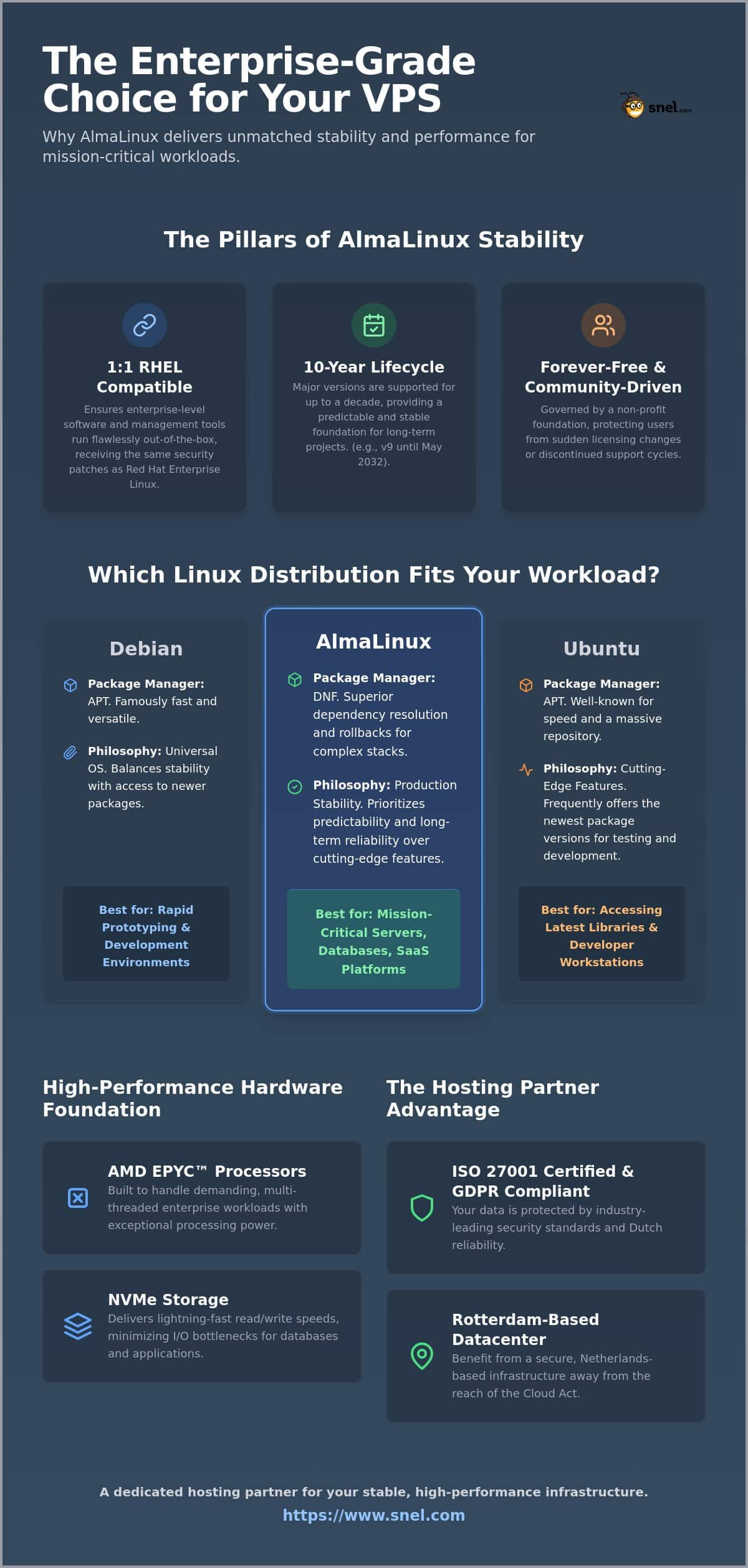
The transition of CentOS to a rolling-release model left many organizations searching for a stable alternative that wouldn’t compromise their production environments. AlmaLinux emerged as a community-driven response, governed by a non-profit foundation rather than a single corporate entity. This structure guarantees that the operating system remains a “Forever-Free” resource, protecting users from the risk of sudden licensing changes or discontinued support cycles.
Transitioning to this environment is made simpler by the ELevate tool, which supports migrations from older CentOS versions without requiring a complete system wipe. This utility handles the heavy lifting of package transitions, allowing you to move to a modern AlmaLinux VPS while preserving your existing configurations. It provides a clear path forward for those who value long-term reliability over the “move fast and break things” philosophy of rolling distributions.
The RHEL lineage and binary compatibility
Being 1:1 binary compatible with Red Hat Enterprise Linux means that every security patch and kernel update is identical to the upstream source. This precision allows enterprise-level software and VPS Hosting management tools to run out-of-the-box with zero modifications. It removes the guesswork from server administration, as you can rely on the same battle-tested code used by global corporations.
This lineage also brings a predictable lifecycle that is essential for business planning. Major versions of AlmaLinux receive security support for up to 10 years, mirroring the RHEL timeline. For example, version 9.x will be supported until May 2032, providing a stable horizon for your applications. This long-term commitment allows you to build and scale your infrastructure with the confidence that your base OS won’t require a disruptive overhaul every few years.
AlmaLinux vs. Debian and Ubuntu: A performance comparison
Choosing the right operating system for your server often comes down to how you prefer to manage your software and updates. AlmaLinux utilizes DNF, the successor to YUM, which is highly regarded for its intelligent dependency resolution and clean rollbacks. In contrast, Debian and Ubuntu rely on APT. While APT is famously fast, DNF is often preferred by system administrators for its rigorous metadata handling. This makes an AlmaLinux VPS exceptionally reliable when managing complex enterprise stacks where a single broken dependency could disrupt your entire workflow.
There is a fundamental trade-off between stability and “freshness.” Debian and Ubuntu frequently offer newer package versions, which is great for testing the latest features. AlmaLinux prioritizes predictability. Think of it as a tailored business suit compared to a Swiss Army knife. The suit is designed for a specific, high-stakes environment: enterprise production. Ubuntu is versatile but often carries extra background services you simply don’t need for a lean, high-performance server. In a virtualized environment, this lean nature translates to a smaller memory footprint and faster boot times.
Which distribution fits your workload?
Your choice should reflect your specific goals. AlmaLinux is the preferred choice for mission-critical web servers, large-scale databases, and ERP systems. If you’re building a SaaS platform that needs to run for several years without the risk of major OS version jumps, this distribution provides the most secure foundation. Its security patch frequency is tied to the RHEL ecosystem, ensuring that critical vulnerabilities are addressed with enterprise-grade speed.
Developers might lean toward Ubuntu or Debian for rapid prototyping because they provide immediate access to the latest libraries and tools. However, once an application moves to a production environment, the focus shifts to long-term reliability and Dutch-standard security. Once your OS is selected, pairing it with the right control panel is equally important — our DirectAdmin vs Plesk comparison breaks down which panel best suits your resource efficiency and multi-tenant management needs in 2026. If you’re currently weighing these options for your project, you can reach out to our experts to discuss which OS best matches your performance requirements. We’re happy to help you find the right balance between cutting-edge features and rock-solid stability.
Optimizing performance with AMD EPYC and NVMe storage
An operating system is only as fast as the hardware it lives on. While AlmaLinux provides the stable software foundation, the actual muscle comes from the underlying processor and storage architecture. AMD EPYC processors are the perfect match for an AlmaLinux VPS because they’re built to handle the multi-threaded nature of enterprise workloads. Whether you’re running high-traffic web servers or complex database queries, the high core counts and massive L3 cache of EPYC ensure your applications never starve for cycles.
We leverage this power in our Pure Performance VPS to give you a competitive edge. Unlike large, impersonal cloud providers that often oversubscribe their nodes, we focus on dedicated resource allocation. This prevents the “noisy neighbor” effect, ensuring that your server’s performance remains consistent regardless of what other users on the host are doing. It’s about providing a predictable, high-speed environment that matches the reliability of the OS itself.
Hardware-level resource isolation
Resource isolation is vital for maintaining Dutch-standard reliability. When your vCPU is dedicated, you don’t have to worry about CPU stealing during peak hours. This isolation ensures that your mission-critical apps have immediate access to the processing power they need. It’s a level of hardware transparency that helps SaaS builders and IT providers maintain strict service level agreements for their own clients.
The role of NVMe in reducing I/O wait times
Storage throughput is the true engine room of your infrastructure. Traditional SSDs are fast, but NVMe drives offer significantly higher IOPS and lower latency. For database-heavy enterprise apps, this means I/O wait times are virtually eliminated. Your AlmaLinux environment can process thousands of concurrent transactions without the disk becoming a bottleneck. This speed is supported by our green Rotterdam datacenter, which uses advanced cooling to maintain a PUE of less than 1.15, ensuring your high-performance setup is also sustainable.
If you’re planning a resource-intensive deployment and need to ensure your hardware is up to the task, contact our team today. We’re ready to help you configure a solution that maximizes both speed and stability.
Managed vs. unmanaged hosting: Finding your AlmaLinux partner
Deploying an AlmaLinux VPS is a smart technical move, but the management style you choose determines your long-term success. While global hyperscalers rely on clinical automation and ticket queues, we focus on a neighborly expert approach. You shouldn’t have to navigate complex infrastructure challenges alone. For teams without a dedicated DevOps department, a Managed VPS serves as a reliable co-pilot. We handle the 24/7 monitoring and security updates, so you can focus on your code.
The Snel.com difference in the Netherlands
Data residency in Rotterdam provides more than just low latency; it offers a legal safe harbor. Because your data stays within Dutch borders, you are protected by strict GDPR regulations and avoid the jurisdictional reach of the US Cloud Act. This compliance is backed by our ISO 27001 certification, which verifies our commitment to information security through rigorous external audits. You get the peace of mind that comes with knowing exactly where your production data lives.
Personal service means having a partner who speaks your language and understands your specific tech stack. We reject corporate anonymity in favor of direct, human connections. Whether you need help with a complex migration or advice on scaling your resources, our in-house team is ready to assist at any level. It’s about providing the expert guidance you need to maintain a secure and efficient server environment without the stress of self-management. For workloads that have outgrown a virtual environment, our fully managed dedicated server buying guide covers the essential 2026 hardware benchmarks and compliance considerations to help you plan your next infrastructure step.
Secure your digital future with a stable foundation
Choosing an AlmaLinux VPS is more than just a technical decision; it’s a commitment to long-term stability and enterprise-grade performance. You’ve seen how 1:1 RHEL compatibility ensures a seamless transition and how the synergy between AMD EPYC hardware and NVMe storage keeps your applications running at peak efficiency. By hosting in our Rotterdam-based datacenter, you’re not just getting a server. You’re securing your data with ISO 27001 certified security and full GDPR compliance.
We believe that high-performance hosting is best when it’s paired with a human touch. Our 4.8/5 Google Review Rating reflects our dedication to being a neighborly expert who is always ready to assist. Whether you’re scaling a SaaS platform or managing a complex database, we’re here to act as your dedicated partner. It’s time to move away from impersonal automation and toward a hosting relationship built on trust and expertise.
Ready to take the next step? Get expert advice on your AlmaLinux configuration to ensure your environment is perfectly optimized for your specific needs. We’re looking forward to helping your business thrive.
Frequently Asked Questions
Is AlmaLinux 100% compatible with CentOS?
Yes, AlmaLinux is 1:1 binary compatible with Red Hat Enterprise Linux (RHEL), which makes it a direct, drop-in replacement for the classic CentOS model. Because it tracks the upstream RHEL source code exactly, any applications or scripts that ran on CentOS will function perfectly on this distribution. You get the same stability and package management without the uncertainty of a rolling-release cycle.
How do I migrate my existing server to an AlmaLinux VPS?
You can migrate an existing server using the ELevate tool, which is an open-source project designed specifically for in-place upgrades between major versions. This tool allows you to move from CentOS 7 to AlmaLinux 8 or 9 while preserving your data and configurations. For those who prefer a fresh start, our team can help you deploy a new AlmaLinux VPS and guide you through the process of transferring your files and databases.
What is the difference between AlmaLinux and Rocky Linux?
The main difference lies in governance and ownership models rather than technical performance. AlmaLinux is owned and governed by a 501(c)(6) non-profit foundation, ensuring it remains community-driven and free from corporate control. Rocky Linux is also a RHEL-compatible fork but operates under a different organizational structure. For most users, an AlmaLinux VPS provides the same enterprise-grade reliability and security as any other RHEL-based system.
Does Snel.com offer managed AlmaLinux services?
Yes, we provide fully Managed VPS services where our in-house experts take over the technical heavy lifting of your server. This includes 24/7 monitoring, proactive security patches, and OS updates tailored specifically for the AlmaLinux environment. It’s an ideal solution for SMEs or developers who want the power of an enterprise OS without the burden of daily server administration.
Where is my AlmaLinux data physically stored?
Your production data is physically stored in our green datacenter located in Rotterdam, the Netherlands. This ensures your infrastructure benefits from Dutch reliability and full compliance with GDPR regulations. We maintain strict ISO 27001 standards to protect your information, and we only use offsite locations in Frankfurt for disaster recovery backups; your active data never leaves the Netherlands. To further strengthen your infrastructure against modern threats, our guide on Linux server hardening walks you through the practical security steps needed to protect your environment against 2026 threat vectors.