


Unpatched kernel vulnerabilities contributed to 32% of ransomware incidents according to the Verizon 2024 DBIR. It’s a sobering figure that highlights why default configurations are no longer enough for modern infrastructure. You likely feel the pressure of keeping your systems safe while juggling complex GDPR requirements and the constant fear of data loss. Effective Linux server hardening shouldn’t be a manual, time-consuming burden that drains your energy. We believe security should be a reliable foundation that gives you peace of mind, not a source of daily stress.
This guide will show you how to master the technical and operational steps required to secure your infrastructure against 2026 threat vectors. You’ll gain the confidence that comes with a stable, compliant environment and automated workflows that handle the heavy lifting for you. We’ll walk through everything from addressing high-impact vulnerabilities like GhostLock to implementing the latest CIS benchmarks on your Pure Performance VPS. We’re here to help you turn your servers into a fortress while keeping your focus on what you do best.
Key Takeaways
- Learn how to defend your infrastructure against AI-powered brute force attacks and supply chain risks that make default configurations a liability in 2026.
- Discover the essential technical steps for Linux server hardening, including transitioning to Ed25519 SSH keys and implementing strict network perimeter controls.
- Master the CIS Benchmarks and use OpenSCAP to automate your vulnerability scanning and simplify complex compliance reporting for GDPR.
- Understand how dedicated vCPU allocation in a Pure Performance VPS protects your sensitive data from side-channel attacks while maintaining high processing speeds.
The 2026 Linux Security Landscape: Why Default Configuration Is a Liability
Linux server hardening is the deliberate process of reducing your attack surface by refining configurations and stripping away unnecessary services. A standard Linux VPS installation prioritizes immediate accessibility over security. It often leaves doors open that you don’t actually need. In July 2026 alone, researchers discovered over 3,627 new vulnerabilities in the Linux ecosystem. Relying on factory settings is a significant liability. The goal isn’t just to stop a breach. It’s to build a resilient environment that survives an initial breach attempt.
The Shift Toward AI-Driven Threat Vectors
Attackers now use AI to find idiosyncratic configuration errors. These tools can identify subtle vulnerabilities like GhostLock (CVE-2026-43499), a 15-year-old flaw recently unearthed in the kernel. You can’t just wait for a patch. Proactive Linux server hardening is necessary to close these gaps before they’re discovered. By removing unnecessary modules and hardening your kernel parameters, you stay one step ahead of automated exploitation. It’s about being prepared rather than just being lucky.
Data Residency and the GDPR Compliance Factor
Hosting in the Netherlands offers more than just speed. It provides a legal security layer for EU businesses. We operate our infrastructure from our Rotterdam datacenter, which ensures your production data stays within the jurisdiction of the GDPR. This residency, combined with our ISO 27001 certification, simplifies your compliance journey. It’s about reliability and transparency. You deserve a partner who takes data residency as seriously as you do. Keeping your data local is a powerful defense against international legal complexities.
Essential Technical Steps for Hardening Your Linux VPS
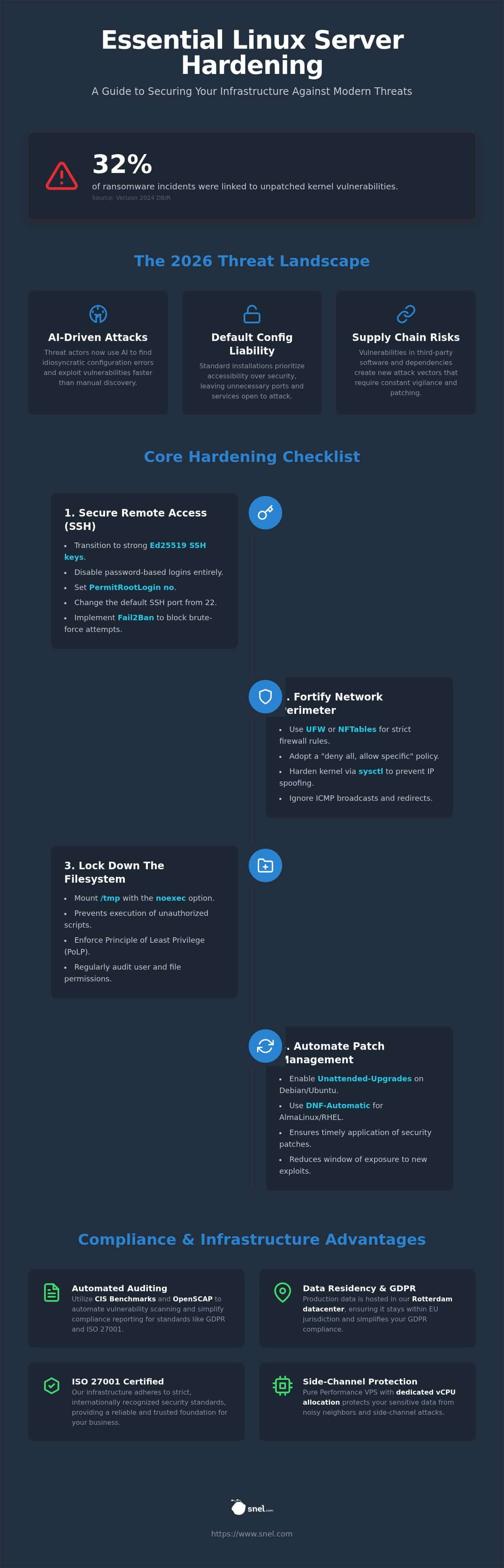
Securing your environment starts with the most common entry point: remote access. Moving away from password-based logins is a non-negotiable part of Linux server hardening. We recommend using Ed25519 SSH keys because they offer better security and performance than older RSA keys. Beyond access, you should refine your kernel settings via sysctl to prevent IP spoofing and ignore ICMP redirects. These small adjustments significantly harden the underlying OS against network-level manipulation. Applying these technical layers is the core of effective Linux server hardening.
Control your network perimeter with a strict firewall policy. Tools like UFW or NFTables allow you to close all ports by default and only open what’s strictly necessary for your Linux VPS. Similarly, filesystem security involves more than just user permissions. Mounting temporary directories like /tmp with the “noexec” option prevents attackers from executing malicious scripts in world-writable locations. It’s a simple step that stops many automated exploits in their tracks.
SSH Configuration and Port Management
Automated bots constantly scan for port 22. You can reduce this noise by changing your SSH port and setting “PermitRootLogin no” in your sshd_config file. This forces attackers to guess both a non-standard port and a specific username. For an extra layer of protection, Fail2Ban monitors your logs and temporarily bans IP addresses that show signs of malicious intent. This helps keep your logs clean and your CPU cycles focused on your actual work.
Automated Patch Management Strategies
Keeping your software current is your best defense against newly discovered exploits. On Debian or Ubuntu, “Unattended-Upgrades” handles security patches automatically. If you’re running a Managed Ubuntu VPS, expert oversight eliminates the risk of a failed kernel update disrupting your production environment. If you’re using an AlmaLinux VPS: The Enterprise-Grade CentOS Successor Compared, DNF-Automatic provides similar peace of mind. If you find these technical configurations daunting, reach out to our support team to discuss how we can help secure your setup.
Advanced Compliance: Frameworks and Automated Auditing
Professional Linux server hardening relies on structured frameworks rather than guesswork. The Center for Internet Security (CIS) provides benchmarks that serve as a definitive roadmap for secure configurations. To maintain a high security posture in 2026, you should integrate OpenSCAP for automated vulnerability scanning. The latest version, 1.4.4, allows you to translate complex security policies into actionable compliance reports. This ensures your infrastructure meets strict standards like ISO 27001 while saving your team hours of manual auditing.
Effective security also requires the Principle of Least Privilege (PoLP). Every service account on your server should only have the minimum permissions required to function. If a specific service is ever compromised, PoLP restricts the attacker’s ability to move through your system. Pair this with immutable audit logs. By offloading your logs to a remote, write-only location, you ensure that even if a root account is breached, the evidence of the intruder’s actions remains untouched for later forensics.
Implementing CIS Benchmarks on Production Systems
CIS profiles are divided into two levels. Level 1 provides a base security level that is practical and has minimal impact on performance. Level 2 is designed for high-security environments where data sensitivity is paramount, though it can be more restrictive for certain applications. We always recommend testing your hardening scripts in a staging environment first. It’s the most reliable way to confirm that a new security policy doesn’t accidentally disrupt your production services.
Intrusion Detection and Integrity Monitoring
Tools like AIDE or Tripwire act as a digital tripwire for your filesystem. They create a baseline of your critical files and alert you immediately if any unauthorized changes occur. This monitoring is essential for detecting sophisticated breaches that bypass traditional firewalls. While internal integrity is vital, you must also defend against external disruptions. Combining internal hardening with a DDoS protected VPS Netherlands ensures your services remain available even during large-scale network attacks.
Balancing Security and Performance with Managed Infrastructure
Hardware is the foundation of any robust security strategy. A Pure Performance VPS offers dedicated vCPU allocation, which provides more than just raw speed. It creates a physical barrier that helps prevent side-channel attacks, such as those exploiting shared processor resources in high-density environments. When you combine this with high-speed NVMe storage, you can implement full-disk encryption without the typical latency penalties. This hardware-level isolation is a critical, often overlooked component of Linux server hardening.
Deciding between a self-managed or a Managed VPS depends on your team’s daily capacity. An unmanaged setup gives you total control, but you carry the full weight of 24/7 monitoring and patching. Our managed services shift that burden to our team. We handle the initial Linux server hardening and provide constant oversight to catch anomalies before they escalate. If a breach attempt occurs, having a solid recovery plan is vital. Integrating Acronis Cyber Protect Backup ensures you can restore your data quickly, providing essential resilience against ransomware.
When to Choose Managed VPS for Security
Infrastructure as the Final Hardening Layer
Your security strategy ends where your data lives. Our Rotterdam datacenter is ISO 27001 certified, which means physical access and operational procedures meet the highest international standards. This Dutch reliability, combined with strict data residency, creates a final layer of trust for your users. Security isn’t a one-time project; it’s an ongoing rhythm. With a dedicated hosting partner, you ensure your infrastructure remains a stable, secure home for your data.
Take Control of Your Infrastructure Security
The security landscape of 2026 demands a shift from default settings to a proactive, layered defense. You’ve seen how precise Linux server hardening reduces your attack surface by combining strict SSH protocols with automated compliance auditing. By choosing infrastructure that offers dedicated vCPU allocation and NVMe speed, you ensure that your security measures never compromise your server’s performance. It’s about creating a balance where protection and efficiency work in harmony.
We’re here to be your dedicated partner in this journey. Our Rotterdam-based datacenter ensures your data residency remains strictly in the Netherlands, while our ISO 27001 certification provides the transparency you need for GDPR compliance. You don’t have to face these technical challenges alone. Our team provides 24/7 expert human support to keep your systems stable and resilient. We’re committed to your success and ready to help you navigate the complexities of modern server security.
Let’s build a faster, safer environment for your users together.
Frequently Asked Questions
What is the first step I should take to harden a new Linux VPS?
You should immediately update your package repositories and secure your remote access. Run a full system update using your package manager to patch any known vulnerabilities that exist in the base image. Once updated, switch from password-based authentication to Ed25519 SSH keys and disable root login. This simple combination closes the most common entry points for automated bots before you even begin installing your application stack.
Does server hardening significantly impact website loading speeds?
Proper hardening usually improves performance rather than slowing it down. By disabling unnecessary background services and removing unused software modules, you free up valuable CPU cycles and RAM. While features like encrypted filesystems introduce a tiny bit of processing overhead, high-speed NVMe storage on a Pure Performance VPS ensures your site remains snappy. You get a leaner, faster environment that prioritizes your actual workloads over unneeded system bloat.
How often should I audit my Linux server security configuration?
We recommend running automated vulnerability scans every week and performing a deep manual review every quarter. Automated tools like OpenSCAP can catch recent kernel flaws like GhostLock (CVE-2026-43499) without requiring your constant attention. Quarterly reviews are perfect for checking if your user permissions and firewall rules still match your current team structure. Regular audits ensure your security posture evolves alongside new threats and internal changes.
What is the difference between a firewall and server hardening?
A firewall is a specific tool for network control, whereas Linux server hardening is a comprehensive security strategy. Your firewall acts as a gatekeeper that decides which traffic can enter or leave your server. Hardening goes much deeper by securing the kernel, managing user privileges, and keeping software updated. Think of the firewall as a sturdy front door and hardening as the structural integrity that keeps the entire building safe from the inside out.
Can I automate the hardening process for multiple Linux servers?
Yes, you can use configuration management tools like Ansible or Chef to apply security baselines across your entire fleet. Automation is highly effective because it eliminates human error, which was the top cause of downtime for 69% of organizations according to the ITIC 2024 Global Server Reliability Report. By using scripts to deploy your firewall rules and SSH configurations, you ensure every server in your infrastructure meets the same high standard of protection from day one. To further reduce your attack surface, carefully evaluating your server management software is equally important — the DirectAdmin vs Plesk comparison can help you choose a control panel that keeps resource overhead and security exposure to a minimum.