


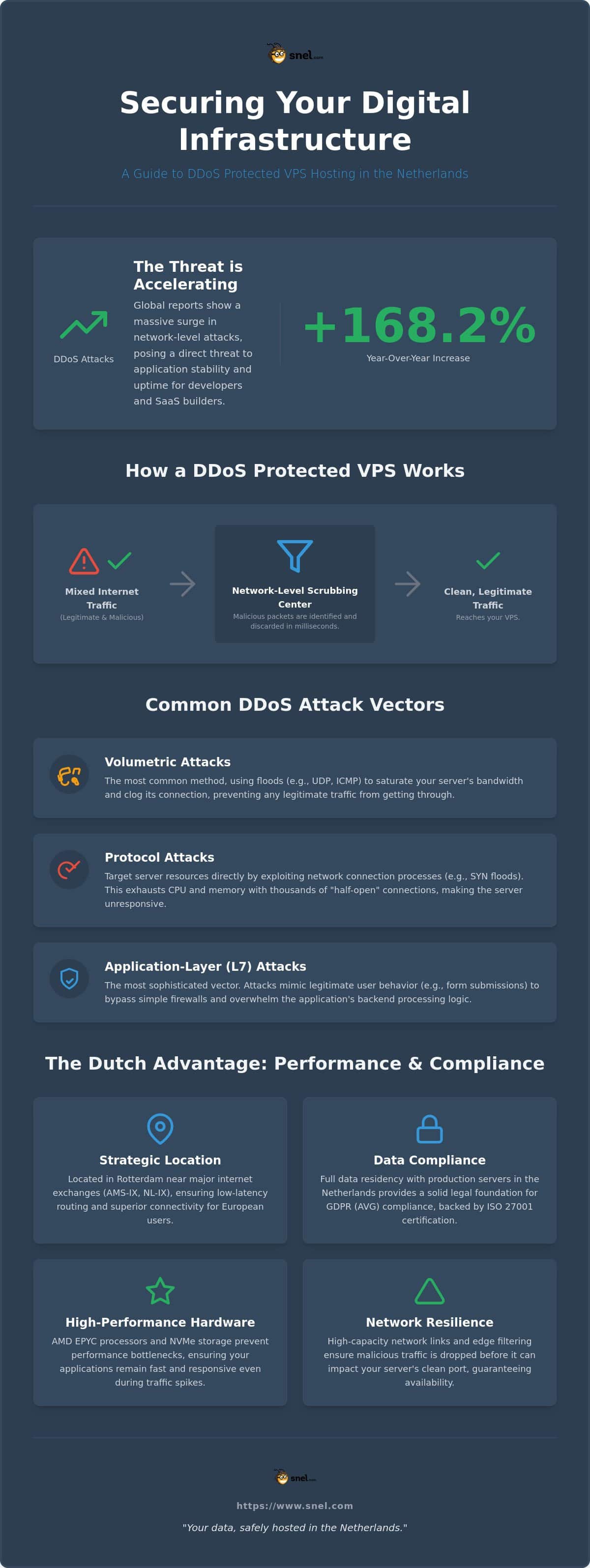
According to global infrastructure reports from early 2026, network-layer DDoS attacks increased by 168.2% year-over-year. For developers and SaaS builders, this isn’t just a technical statistic; it’s a direct threat to the stability of your applications. You likely already feel the pressure of maintaining a 100% uptime record while facing increasingly sophisticated botnets. It’s even worse when your provider offers only automated replies during a critical incident. Choosing a DDoS protected VPS Netherlands means more than just adding a shield. It’s about maintaining low-latency performance for your European users while staying fully GDPR compliant.
In this guide, you’ll learn how to secure your virtual infrastructure using high-performance Dutch hosting with advanced mitigation layers. We’ll show you how a resilient setup provides the strength needed to withstand multi-vector attacks without sacrificing speed. We will also cover how Rotterdam-based data residency and the NIS2 Directive ensure your compliance. Finally, we’ll explain why having direct access to human network experts makes all the difference when every second counts for your business.
Key Takeaways
- Understand how scrubbing centers clean incoming data at the network level to block malicious traffic before it impacts your applications.
- Leverage the connectivity of Rotterdam-based data centers and AMS-IX to ensure low-latency access for your Western European users.
- Discover how a DDoS protected VPS Netherlands provides the necessary infrastructure resilience to withstand the sophisticated multi-vector attacks of 2026.
- Learn how hardware layers featuring AMD EPYC processors and NVMe storage prevent database throttling and maintain performance during traffic spikes.
- Identify the critical factors for choosing a hosting partner, including transparent 100% uptime SLAs and the ability to scale resources independently.
What is a DDoS Protected VPS and How Does it Work?
A VPS is a virtualised server that provides dedicated resources within a shared physical host. When you choose a DDoS protected VPS Netherlands, you’re adding a sophisticated defense layer that sits between your server and the public internet. This setup integrates network-level filtering to block malicious traffic before it ever reaches your server’s operating system. It’s a proactive approach to security that ensures your applications remain reachable, even when the network environment becomes hostile.
The heavy lifting happens in what we call scrubbing centres. These are specialized facilities where incoming data is cleaned of malicious packets. As traffic flows toward your Pure Performance VPS, advanced filtering hardware analyzes each packet for signature patterns of known attacks. Malicious requests are discarded instantly. Legitimate users experience no noticeable delay, as the cleaning process occurs in milliseconds at the network edge.
Standard VPS hosting is often vulnerable to volumetric spikes that can saturate your entire bandwidth. In a protected environment, your resource availability is the priority. Your CPU and RAM stay focused on your actual workload instead of being exhausted by junk traffic. This resilience is what separates a professional hosting partner from a basic utility provider; it’s about keeping you online when it matters most.
Common Attack Vectors Targeting Virtual Infrastructure
Volumetric attacks are the most common “brute force” methods. By using UDP or ICMP floods, attackers try to saturate your bandwidth with massive amounts of data. The goal is to clog your connection so completely that no legitimate traffic can get through.
Protocol attacks, such as SYN floods, target the server’s resources rather than its pipe. They exploit the handshake process used to establish network connections. By opening thousands of “half-open” connections, they exhaust your CPU and memory, making the server unresponsive to real users.
Application-layer attacks, or Layer 7 attacks, are the most sophisticated. They mimic legitimate user behaviour, such as loading a heavy web page or submitting a form. Because they look like real traffic, they can bypass simple firewalls and crash your web server by overwhelming its backend processing logic.
The Advantages of Hosting a DDoS Protected VPS Netherlands
The Netherlands serves as a primary gateway for European digital traffic. Proximity to major internet exchanges like AMS-IX and NL-IX allows for fast routing and exceptional connectivity. When you deploy a DDoS protected VPS Netherlands, your data is positioned at the heart of the continent’s network backbone. This isn’t just about speed; it’s about network resilience. High-capacity links ensure that even during massive traffic spikes, your server remains accessible to the users who matter most.
Dutch infrastructure is known for its efficiency and sustainability. Our Rotterdam data centre operates on 100% green energy, as verified by our own data centre measurements, and maintains high PUE efficiency based on our internal infrastructure audit. If you want to understand how a green data center Netherlands achieves this level of efficiency without compromising performance, our technical reference guide covers the measured PUE figures and energy standards in detail. Beyond environmental benefits, hosting here provides a solid legal foundation. Because all production servers remain within the Netherlands, you maintain full data residency. This is essential for GDPR (AVG) compliance, especially for SMEs and SaaS builders handling sensitive European user data. Our commitment to security is further backed by our official ISO 27001 certification, ensuring that your data, safely hosted in the Netherlands, meets the highest international standards. If you have specific questions about our network topology, you can always reach out to our support team for a technical deep dive.
Technical Layers of Effective DDoS Mitigation
Effective defense starts with powerful hardware. We use AMD EPYC processors because they handle the heavy computational overhead required for encrypted traffic filtering. When your virtual infrastructure is under fire, these processors ensure your legitimate applications don’t lag while the system inspects packets. To prevent the local network port from becoming a bottleneck, our infrastructure filters traffic at the network edge. This means junk data is dropped before it even enters our internal network, keeping your server port clean for real users.
Consistency is key during an attack. We utilize NVMe storage to ensure that database operations are not throttled when traffic surges. While standard SSDs might struggle with high I/O requests during a flood, NVMe provides the throughput needed to keep your services running smoothly. Automated scrubbing rules are integrated directly into the stack. These rules detect anomalies and act within seconds to neutralize volumetric threats, providing a reliable first line of defense that never sleeps.
Automated Scrubbing vs. Expert Human Intervention
Automation is efficient, but it isn’t perfect. Standard filters handle approximately 95% of common network-layer attacks, according to our own measurement of historical mitigation logs. However, complex Layer 7 attacks often mimic real user behavior. These sophisticated threats require manual rule adjustments to avoid blocking legitimate customers. It’s a delicate balance between security and accessibility that only experienced eyes can manage.
This is where our team steps in. We provide 24/7 expert monitoring by in-house technicians who understand every corner of the network. You won’t get an automated bot or a scripted response; you’ll reach a person who provides technical answers on the first message. For businesses without a dedicated security team, a Managed VPS approach offers a completely hands-off experience. We handle the mitigation and fine-tuning while you focus on building your product.
How to Choose a Reliable DDoS Protected VPS Partner
Selecting the right provider for a DDoS protected VPS Netherlands is a decision that impacts your business stability for years. It’s about finding a hosting partner that values transparency over fine print. Start by reviewing the Service Level Agreement (SLA). A reliable partner should offer a 100% uptime guarantee. This isn’t just a number; it’s a commitment that your applications stay online when your customers need them most. If a provider hides behind vague uptime claims, they likely lack the network capacity to back them up.
Flexibility is another critical factor. Your infrastructure needs to grow with your user base. Look for plans that allow you to scale vCPU and RAM independently. You shouldn’t be forced into a higher tier just because you need a bit more memory for your database. We also recommend choosing a partner that offers monthly cancellable plans. This keeps the provider focused on service quality and ensures they continue to earn your trust every single month. Avoid long-term lock-ins that limit your agility. To help you audit your provider against the right criteria, our managed VPS evaluation checklist for business infrastructure in 2026 walks you through the exact technical and operational standards you should verify before committing.
Security Compliance and Data Residency
Knowing exactly where your data lives is essential for legal audits and performance. Our production servers are located in Rotterdam, ensuring your data remains under Dutch jurisdiction. While we store offsite backups in Frankfurt to ensure geographic redundancy within the EU, your production data never leaves the Netherlands. This setup is crucial for maintaining strict GDPR (AVG) compliance. It’s the only way to be certain about data sovereignty.
Beyond digital sovereignty, the physical infrastructure of these facilities relies on advanced electrical and security systems. To see how these critical components are managed in professional Dutch environments, you can learn more about ELVION GROUP.
Verify that your provider holds the ISO 27001 certification. This standard proves that every process, from physical security to internal data handling, meets international safety requirements. With over 20 years of operational experience, we’ve built a foundation of Dutch reliability you can count on. It’s about more than just hardware; it’s about a partnership that grows with you. If you’re looking to simplify server administration alongside your security setup, a Plesk VPS gives you a visual command center to manage your protected infrastructure without relying on the command line. Choosing a DDoS protected VPS Netherlands from an established specialist ensures your infrastructure is ready for the challenges of 2026 and beyond. Pairing your protected environment with a stable, enterprise-grade operating system like an AlmaLinux VPS further reduces risk by eliminating the threat of unexpected end-of-life disruptions at the OS level.
Building Your Resilient Digital Future in 2026
The digital landscape of 2026 demands a shift from reactive security to proactive resilience. By combining the raw power of AMD EPYC hardware with the strategic location of our Rotterdam data centre, you ensure your applications remain fast and reachable. We’ve explored how automated scrubbing and human expertise work together to neutralize even the most complex Layer 7 threats. Your choice of a DDoS protected VPS Netherlands isn’t just a technical decision. It’s a commitment to your users’ trust and your business’s long-term stability.
We take that commitment seriously. Our infrastructure is ISO 27001 certified and powered by 100% green energy, keeping your data residency local and your environmental impact low. You don’t have to navigate these technical challenges alone. Our 24/7 in-house experts are ready to act as an extension of your team, providing the direct support you need to stay ahead of evolving botnets. It’s time to move beyond unpredictable downtime and embrace a hosting partnership built on transparency and Dutch reliability. For those expanding their operations globally, you can also discover Parcel International to manage your international shipping and logistics with the same efficiency.
Deploy your resilient DDoS protected VPS in the Netherlands today and start building with confidence.
Frequently Asked Questions
How does DDoS protection affect my VPS latency?
Network-level protection has a negligible impact on latency, often passing legitimate packets with a delay under 10 milliseconds. By using a DDoS protected VPS Netherlands, you leverage the country’s high-density fibre network for consistent performance. This edge-based filtering ensures that even during a scrubbing event, your users in Europe won’t notice a slowdown. Software-based alternatives often cause lag, which is why we prioritise hardware mitigation for production workloads.
Is DDoS protection included by default on all VPS plans?
Most professional hosting plans include baseline automated protection to stop common volumetric attacks. For higher-risk projects like SaaS platforms or e-commerce sites, you should look for advanced mitigation that offers higher capacity and custom rule-sets. It’s vital to have access to 24/7 expert support. If an attack bypasses automated filters, human technicians can step in to apply manual rules immediately.
Can I scale my DDoS protected VPS as my traffic grows?
Yes, our cloud infrastructure supports modular scaling of vCPU, RAM, and NVMe storage independently. You don’t need to perform a time-consuming migration to a new server just to add resources. This scalability is a core part of a Pure Performance VPS, allowing you to grow as your application demands. Monthly billing ensures your costs stay aligned with your actual resource usage without long-term commitments.
What is the difference between software and network-level DDoS protection?
Software protection runs on your server and consumes CPU and RAM, which can lead to a crash during intense attacks. Network-level protection happens at the data centre’s edge using dedicated scrubbing hardware. This filters malicious traffic before it ever reaches your virtual environment. It keeps your server resources dedicated to your applications, providing much better resilience against both volumetric and protocol-based threats.
Does a DDoS protected VPS help with GDPR compliance?
DDoS mitigation directly supports GDPR compliance by ensuring the “availability and resilience” of your processing systems as required by Article 32. When you combine this with a provider that hosts data exclusively in Rotterdam and holds ISO 27001 certification, you meet strict European standards. This combination of technical security and legal data residency is a significant advantage for any business operating within the EU.