

Did you know that data centers in the Netherlands consumed as much energy as nearly two million households combined over the last year? It’s a staggering figure that explains why the Amsterdam area has paused new developments until at least 2030. You want your infrastructure to be part of the solution, but you likely worry that a green data center Netherlands might lack the performance of traditional, power-hungry alternatives. It’s frustrating to choose between your environmental values and your site’s speed, especially when greenwashing makes it hard to tell which claims are actually backed by hardware.
We agree that sustainability shouldn’t be a trade-off. In this guide, you’ll learn how Dutch efficiency standards and 100% green energy integration provide a rock-solid foundation for high-performance digital growth. We will explore our own measured PUE of under 1.15, the security of Dutch data residency, and how strict ISO 27001 compliance ensures your peace of mind. We’ll also explain why we keep all production data in Rotterdam for maximum reliability. This is your technical roadmap to hosting that is as fast as it’s responsible.
Key Takeaways
- Identify verified sustainable providers using the Green Web Foundation database to ensure your hosting is genuinely eco-friendly.
- Understand how a Power Usage Effectiveness (PUE) below 1.15 serves as the technical benchmark for a green data center Netherlands.
- Differentiate between direct green energy sourcing and carbon offsets to ensure your infrastructure has a minimal environmental footprint.
- Explore how modern hardware stacks, such as AMD EPYC processors, allow you to meet EU ESG reporting requirements without sacrificing performance.
- Learn why keeping production data in Rotterdam provides a secure, GDPR-compliant foundation for your digital operations.
What Defines a Green Data Center in the Netherlands?
A green data center Netherlands is a facility designed from the ground up to minimize its environmental footprint. It isn’t just about the electricity coming through the walls; it’s about the efficiency of every server rack and cooling unit inside. In the Netherlands, this means moving beyond simple carbon offsets. Truly sustainable infrastructure combines 100% renewable energy with high-performance hardware that does more with less power. Dutch facilities lead Europe because they integrate advanced cooling techniques with a national grid that is increasingly powered by offshore wind and solar. Sustainable hosting acts as the bedrock for a future-proof digital strategy.
The Green Web Foundation Certification
Transparency is essential when you’re trying to avoid greenwashing in your supply chain. The Green Web Foundation provides a verified database that tracks which hosting providers actually use green energy. Their verification process requires providers to prove their claims with evidence of renewable energy contracts or certificates. By choosing a certified partner, you ensure your digital footprint is backed by real action rather than vague marketing. It’s a simple way to verify that your VPS or dedicated infrastructure isn’t secretly running on carbon-heavy power sources.
ISO 27001 and Environmental Compliance
Operational efficiency and security often go hand in hand. ISO 27001 certification isn’t just a badge for data security; it’s a framework for disciplined management that reduces waste. For many EU enterprises, Dutch data residency is a non-negotiable requirement for compliance. We host all production data in our Rotterdam facility to ensure it stays within the Netherlands. This local focus simplifies GDPR compliant hosting while allowing us to maintain enterprise-grade hardware, such as AMD EPYC processors, which offer superior performance-per-watt compared to older generations. Reliable hosting should be both secure and sustainable.
The Role of Power Usage Effectiveness (PUE) and Hardware Efficiency
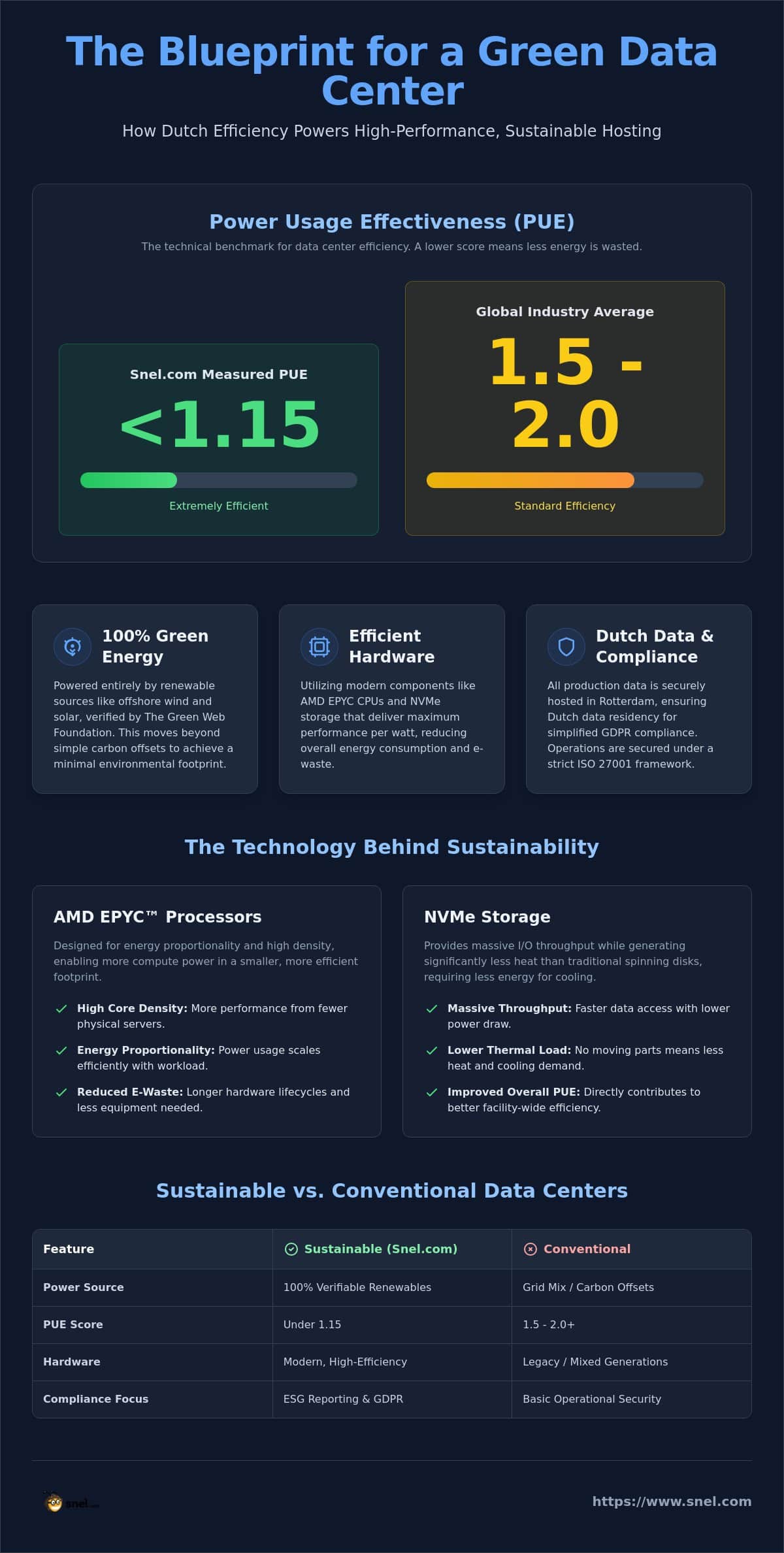
A green data center Netherlands is best evaluated by its Power Usage Effectiveness (PUE). This metric is the ratio of total facility power divided by the power delivered to your IT equipment. While the global industry average often hovers between 1.5 and 2.0, advanced facilities in the Netherlands achieve significantly better results. Based on our own measurement, our facility maintains a PUE below 1.15. A lower score means less energy is wasted on non-computing tasks like cooling or lighting. It ensures that the renewable energy we procure is actually doing the work you need.
Hardware selection is the real engine of sustainability. It doesn’t matter how green your power source is if your servers are inefficient. Modern components do more work per watt, allowing for higher performance without a proportional increase in energy consumption. This focus on internal efficiency is what separates a truly sustainable operation from one that simply buys carbon credits to hide legacy waste.
AMD EPYC and Energy Proportionality
Modern processors like AMD EPYC are designed for energy proportionality. They provide high core density, which allows us to fit more computing power into a smaller physical footprint. This efficiency is the backbone of our Pure Performance VPS. By using fewer physical servers to handle the same workload, we reduce the total energy draw and the amount of e-waste generated over time. It’s a technical choice that directly supports your ESG reporting goals.
NVMe Storage and Thermal Load
Storage choice also plays a critical role in the thermal load of a rack. NVMe storage provides massive throughput while generating less heat than traditional spinning disks. Since these drives don’t have moving parts, they require less energy to operate and less cooling to maintain optimal temperatures. This reduction in heat directly improves the overall PUE of the facility. If you have questions about how our hardware choices affect your project, you can always reach out to our team for a transparent look at our specs.
Sustainable vs. Conventional Data Centers: A Comparative Framework
Choosing between a legacy facility and a modern green data center Netherlands comes down to how energy is handled. Traditional data centers are like old incandescent bulbs that waste most of their energy as heat. In contrast, green facilities operate like precision-tuned LEDs, directing every watt toward productive work. This difference starts with ownership. Because we independently operate our facility, we have absolute control over the hardware lifecycle and cooling configurations. Large, impersonal cloud giants often rely on standardized, one-size-fits-all setups that prioritize scale over surgical efficiency.
Cooling Technologies in Dutch Infrastructure
Conventional cooling often relies on massive CRAC units that blow cold air into a room, hoping it reaches the servers. This is incredibly wasteful because hot and cold air inevitably mix. Modern Dutch infrastructure uses cold-aisle containment to physically separate these airflows. By trapping cold air in a sealed aisle, we ensure it passes through the server intake without escaping. The temperate Dutch climate also allows for extensive free-air cooling. We can pull in filtered outside air to cool the racks for the majority of the year, which drastically reduces the need for energy-heavy mechanical refrigeration.
Direct vs. Indirect Sustainability
There is a massive gap between buying carbon credits and direct green energy sourcing. Many providers “go green” by purchasing offsets to mask their use of fossil fuels. We source 100% of our power directly from local renewable providers. This direct approach ensures that your infrastructure supports the growth of the Dutch renewable grid. For high-demand projects, Dedicated Servers provide an additional layer of optimization. Unlike shared environments where resources are often over-provisioned to compensate for spikes, a dedicated setup allows for precise tuning of power consumption and performance. If you want a transparent comparison of how our infrastructure stacks up against your current provider, get in touch with our experts today.
Strategic Advantages of Hosting on Green Dutch Infrastructure
Aligning your digital operations with sustainable Dutch infrastructure is a strategic business move that addresses increasing regulatory pressure. EU businesses must now navigate the Corporate Sustainability Reporting Directive (CSRD), which requires documented evidence of environmental responsibility across the supply chain. By choosing a provider that uses 100% renewable energy, you gain the verifiable data your stakeholders and regulators demand. This transparency turns your hosting from a background operational cost into a core component of your ESG strategy.
The reliability of the Dutch power grid is among the highest globally, providing a stable foundation for high-performance workloads. We build on this stability by offering 100% uptime SLAs, ensuring your applications remain available without the need for complex, multi-region configurations. A reliable hosting partner acts as a steady hand for your growth, helping you bypass the technical hurdles of infrastructure management while keeping your environmental footprint small. This combination of local expertise and dependable hardware ensures that your scaling is both predictable and responsible.
Data Residency and GDPR Compliance
Keeping your production data within our Rotterdam facility is a prerequisite for ethical and legal sustainability. Knowing the exact physical location of your files simplifies GDPR audits and builds trust with your end users. Our independent, Netherlands-based operations ensure that your data stays within the local jurisdiction, providing a layer of legal certainty that impersonal cloud giants often struggle to provide. For a comprehensive understanding of how server infrastructure aligns with European data protection law, our guide to GDPR compliant hosting for professional server infrastructure covers the full compliance checklist in detail. It is about protecting your corporate reputation while adhering to strict residency requirements.
Managed Sustainability: The Human Element
SMEs and agencies often lack the resources to micromanage server configurations for maximum efficiency. Managed VPS services bridge this gap by handling the technical heavy lifting required to optimize resource usage. We ensure your environment is tuned for performance rather than wasted on idle processes or legacy configurations. This hands-on approach ensures that your infrastructure remains as efficient as possible, allowing your team to focus on building products while we manage the environmental and operational impact.
Building a Resilient Foundation for Your Digital Growth
Sustainability in the digital age requires more than just carbon offsets. It demands a technical commitment to efficiency at every layer of the stack. By choosing a green data center Netherlands, you’re investing in a facility where hardware performance and environmental responsibility work in tandem. Our independent Dutch datacenter provides the transparency you need, from our own measured PUE of under 1.15 to our 100% green energy sourcing. You don’t have to compromise on speed or reliability to meet your ESG goals.
We’ve shown that modern cooling and high-density hardware like AMD EPYC processors can significantly reduce your footprint while keeping your data securely within Dutch borders. It’s about building a future where your infrastructure is as clean as it’s powerful. We’re here to help you navigate this transition with personal service and technical expertise that you won’t find with impersonal cloud providers. Switch to sustainable, high-performance hosting in the Netherlands today. Let’s build something better together.
Frequently Asked Questions
What is a good PUE for a sustainable facility in the Netherlands?
A PUE below 1.2 is the benchmark for efficiency in the Dutch market, but the value is most meaningful when viewed as an annual average. Because the Netherlands has a high number of “free cooling” days where temperatures stay below 12°C, efficient facilities can bypass mechanical refrigeration for most of the year. This seasonal advantage ensures that the energy overhead remains stable even during summer peaks, preventing the efficiency drops common in warmer climates.
Is green hosting in the Netherlands more expensive than traditional hosting?
Sustainable hosting is a long-term value play rather than a premium luxury. Energy-efficient hardware often has a higher thermal ceiling, meaning components can perform at peak capacity longer without thermal throttling. This protects your application’s speed during traffic spikes and reduces the frequency of hardware failures. While the upfront cost of enterprise components is higher, the reduced energy draw and increased hardware lifespan help keep your monthly costs predictable and competitive.
How can I verify if a Dutch hosting provider is actually using green energy?
The most rigorous way to verify green claims is through Guarantees of Origin (GVO). These are official Dutch certificates that track renewable energy from the production source to the socket, ensuring that for every megawatt consumed, an equivalent amount of wind or solar was added to the grid. While membership badges are helpful, GVOs provide the legal audit trail required for formal corporate compliance and ESG reporting.
Does using eco-friendly infrastructure affect my server performance?
Modern green facilities often provide superior performance due to energy-proportional computing. This design allows hardware to consume minimal power when idle while maintaining the ability to ramp up to full capacity with negligible wake-up latency. Because these systems are optimized for efficiency, they are typically paired with the latest virtualization layers that improve resource isolation. This reduces the “noisy neighbor” effect and ensures that your VPS has consistent access to its allocated resources.
What happens to the waste heat generated by Dutch data centers?
Waste heat is now officially recognized as a renewable energy source under the Dutch BENG standards for nearly energy-neutral buildings. This classification allows facilities to provide thermal energy to neighboring structures, helping them meet their own sustainability requirements. By participating in these heat-exchange projects, data centers function as part of a circular economy, turning a computing byproduct into a utility that heats local homes or greenhouses.
This commitment to a circular economy is also visible in the consumer market, where platforms like Hvidevaredele.dk help extend the life of household appliances by providing essential parts for repair. Just as data centers aim to maximize the utility of their energy and hardware, repairing home equipment reduces waste and promotes a more sustainable lifestyle.