


Relying on a global cloud giant for your data privacy often feels like signing a contract written in disappearing ink. You know that protecting user data isn’t just a legal chore; it’s the foundation of trust for your business. Still, the looming threat of heavy fines and the headache of deciphering complex Data Processing Agreements can make any professional feel uneasy. Finding reliable GDPR compliant hosting shouldn’t feel like a gamble against vague corporate promises or shifting international regulations.
We’re here to help you move past that uncertainty. This guide shows you how to align your server infrastructure with European laws while maintaining the high-performance standards your VPS or Enterprise Dedicated Servers require. You’ll gain a clear checklist for infrastructure compliance and learn why keeping production data strictly in a Dutch datacenter is a game-changer. We’ll bridge the gap between technical performance and legal security, positioning you as a trusted partner for your own clients. By the end of this guide, you’ll have a roadmap to navigate Dutch and EU privacy laws with total confidence.
Key Takeaways
- Learn why a professional Data Processing Agreement is vital for defining legal liability and managing the full lifecycle of your data.
- Discover how ISO 27001 standards and AMD EPYC resource isolation create a verified benchmark for technical information security.
- Identify the specific technical and legal requirements for GDPR compliant hosting that protects you from the risks of international data transfers.
- Understand why keeping production data in the Netherlands avoids the reach of the US Cloud Act and ensures complete legal clarity.
- Explore the value of a dedicated hosting partner who provides 24/7 in-house monitoring and a direct connection to expert sysadmins.
What Defines a Professional Server for GDPR Compliance?
What does it actually take to keep your data safe? True GDPR compliant hosting is about more than just pinning a map. It’s a commitment to the entire lifecycle of your data. A professional server environment must account for every stage, from initial collection to secure deletion. This approach ensures that your Pure Performance VPS or Enterprise Dedicated Servers aren’t just fast but legally sound.
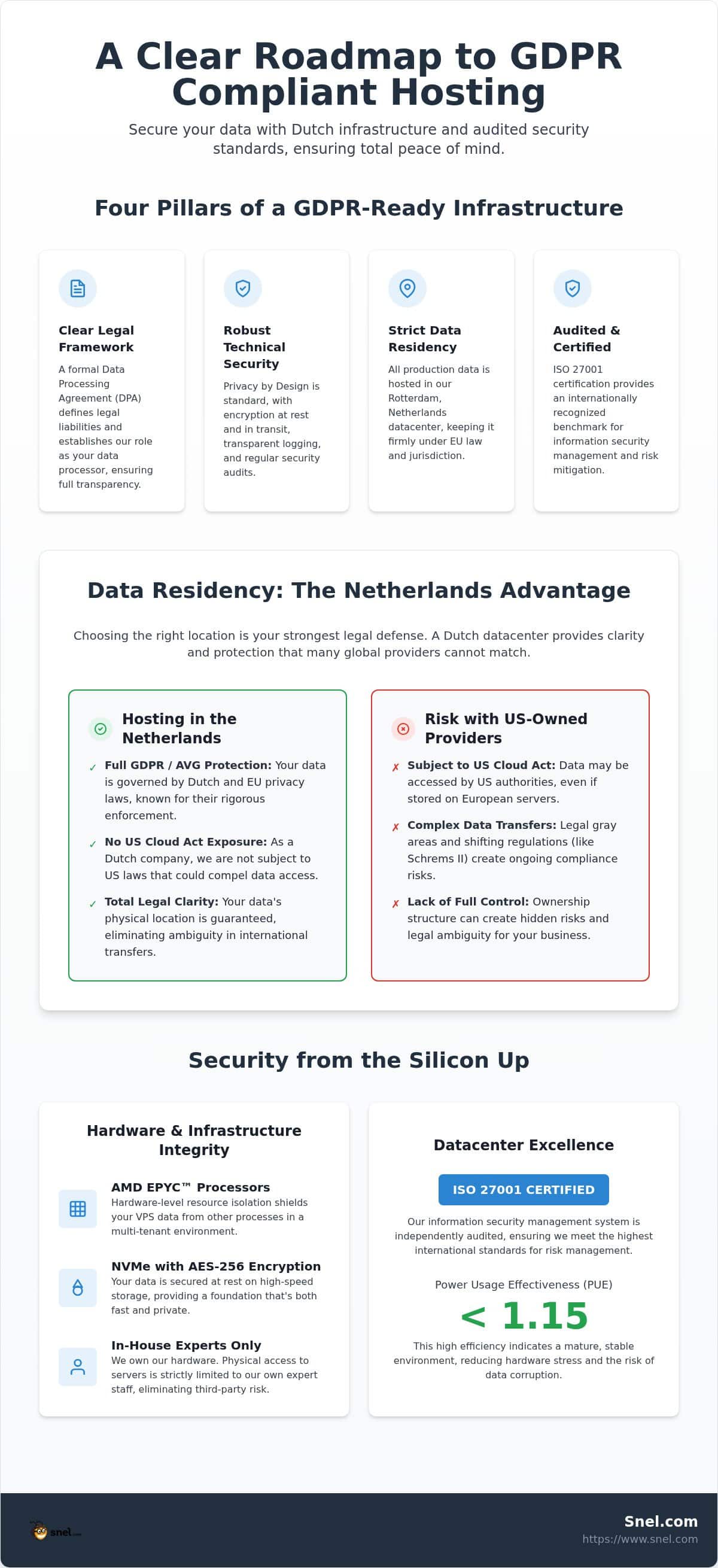
You act as the data controller, while we serve as your data processor. This distinction is vital. A formal Data Processing Agreement (DPA) establishes clear legal liabilities. It outlines exactly how we manage your information, ensuring transparency and accountability for every byte stored in our Rotterdam datacenter. We don’t just host your files; we act as a dedicated partner in your compliance journey.
The Legal Framework: GDPR vs. AVG
The Dutch Algemene verordening gegevensbescherming (AVG) is the local implementation of the EU’s GDPR. While the core rules are the same, the Dutch Autoriteit Persoonsgegevens is known for its rigorous enforcement and high standards for transparency. Choosing a partner with deep roots in the Netherlands means benefiting from a culture of privacy that often exceeds generic EU requirements. Our Dutch reliability isn’t just a slogan; it’s built into how we handle your infrastructure.
Core Compliance Requirements
Strong technical measures are the backbone of any compliant setup. Encryption at rest and in transit ensures that your sensitive information remains unreadable to unauthorized parties. We also prioritize transparent logging and regular security audits. You need a clear trail of who accessed the data and why. By integrating these features into your Managed VPS, you build a Privacy by Design environment that satisfies both regulators and your customers’ expectations.
Technical Standards: ISO 27001 and Infrastructure Integrity
Compliance isn’t just about paperwork; it’s about the physical metal and the processes protecting it. ISO 27001 certification serves as our daily benchmark for information security management. It proves that we have a structured, audited approach to identifying and mitigating risks. For anyone seeking true GDPR compliant hosting, this certification offers the peace of mind that your data is managed under the highest international security standards. It’s the difference between hoping you’re secure and knowing you’re protected.
We believe in total control. Unlike providers who simply resell third-party cloud capacity, we own our physical infrastructure. In our Rotterdam datacenter, physical access to the server racks is strictly limited to our own in-house experts. This elimination of third-party hands reduces the risk of unauthorized physical interference. When you know exactly who can touch your server, your security posture becomes significantly stronger. Owning the metal allows us to guarantee exactly where your data resides at all times.
Data Protection at the Hardware Level
Security starts deep within the silicon. We utilize AMD EPYC processors because they offer advanced resource isolation features. This hardware-level security ensures that even in a multi-tenant environment, your data remains shielded from other processes. Combined with NVMe storage utilizing AES-256 encryption, our Pure Performance VPS provides a high-speed, high-security foundation for your most sensitive applications. It’s performance that doesn’t compromise on privacy.
Sustainability and Security
A stable server is a secure server. Our commitment to operational excellence is reflected in our Rotterdam datacenter’s Power Usage Effectiveness (PUE) of less than 1.15. This high level of efficiency isn’t just about being green; it indicates a mature, well-managed environment where hardware runs at optimal temperatures with minimal stress. This stability reduces the risk of hardware failure and data corruption. If you want to see how these technical standards can fit your specific project, get in touch with our specialists for a personalized recommendation.
Data Residency Strategies: Rotterdam vs. International Transfers
Choosing the right location for your data is a strategic decision that impacts your legal standing. While many global providers offer servers in Europe, their ownership structure often creates a hidden risk. US-based companies are subject to the Cloud Act, which may allow foreign authorities to access data regardless of where the server is physically located. For businesses requiring true GDPR compliant hosting, this creates a legal gray area that’s best avoided by partnering with an independent Dutch provider.
Your production data stays strictly within our Rotterdam datacenter. This ensures that only Dutch and EU laws apply to your active workloads. We maintain a clear boundary between your primary operations and our disaster recovery protocols. While your live environment runs in Rotterdam, we store encrypted offsite backups in Frankfurt. This geographic separation is a standard requirement for robust business continuity, ensuring your data remains safe even in extreme scenarios without compromising your residency requirements.
Benefits of a Netherlands-Based Datacenter
Operating from a single jurisdiction simplifies your compliance audits. You don’t have to juggle multiple legal frameworks or worry about international data transfer agreements. Beyond legal ease, our location offers exceptionally low latency for European users. When combined with our DDoS protected VPS Netherlands protocols, you get a resilient infrastructure that remains fast and accessible under pressure. We utilize over 60 points of presence to ensure global reach, yet the core of your data never leaves the country.
Managing Backups and Redundancy
Redundancy shouldn’t mean a loss of privacy. We use Acronis Cyber Protect to ensure every backup is fully encrypted before it even leaves the Rotterdam site. This end-to-end protection means that even during a disaster recovery event, your information remains unreadable to anyone but you. Our commitment to a 100% uptime SLA is built on this localized resilience. We’ve spent 26 years perfecting this balance of speed, availability, and strict data sovereignty.
The Snel.com Advantage: Personal Support and Dutch Infrastructure
Compliance is ultimately a human responsibility. While global cloud giants rely on automated bots and tiered support tickets, we believe in the power of a personal connection. Knowing exactly who manages your infrastructure is a vital part of maintaining a secure environment. When you choose our GDPR compliant hosting, you gain access to a team of in-house experts who understand your specific setup. We don’t believe in faceless service; we believe in being a dedicated ally for your business.
Our team monitors your servers 24/7 from our own office, not an outsourced call center. This hands-on approach is backed by 26 years of experience in the hosting industry. This operational maturity means we’ve seen the evolution of privacy laws firsthand and have built our processes to withstand the strictest audits. You get the stability of a veteran provider with the agility of a close-knit team that’s always ready to assist.
Flexibility is another core principle of data privacy. GDPR emphasizes data portability, and we support this by offering monthly cancellable plans. We don’t believe in vendor lock-in or restrictive long-term contracts. This freedom ensures you remain in total control of your data lifecycle. It’s a transparent way of doing business that makes GDPR compliant hosting feel like a partnership rather than a burden.
Managed vs. Unmanaged Compliance
Different teams have different needs. If you want to focus entirely on your applications, our managed servers allow you to offload technical maintenance and security patches to our specialists. For developers who prefer total control, our unmanaged options provide full root access. This allows you to implement custom encryption layers or specific software configurations while still benefiting from our secure Dutch hardware foundation.
Getting Started with a Hosting Partner
Complex data requirements are best handled through direct conversation. We invite you to reach out and discuss your infrastructure needs with a real person who understands the technical and legal landscape. Snel.com combines deep technical expertise with a welcoming, hands-on approach that treats your success as our own.
Building a Future-Proof Infrastructure with Dutch Reliability
Securing your digital assets is a long-term commitment. You now have the tools to move beyond vague promises and build a server environment rooted in Dutch reliability. By combining ISO 27001 Certified infrastructure with strict data residency in Rotterdam, you protect your business from the legal uncertainties of global cloud providers. This strategic choice ensures your production data remains under one clear jurisdiction.
Our 100% green energy powered datacenter ensures your growth is sustainable. Our 24/7 in-house expert support means you’re never navigating technical hurdles alone. This blend of high-performance hardware and human expertise is what makes a truly GDPR compliant hosting strategy successful. It’s about creating a space where your data is safe, your performance is peaked, and your legal liabilities are minimized.
We’re ready to help you secure your data and scale your infrastructure with confidence. Let’s build something reliable together.
Frequently Asked Questions
Is EU-based hosting enough for GDPR compliance?
Physical location is a major factor, but it isn’t a complete solution on its own. True compliance requires a signed Data Processing Agreement, encryption at rest, and strict access controls. US-owned companies often face challenges because they’re subject to the Cloud Act, which can allow foreign access to EU servers. Choosing a locally owned Dutch provider ensures your infrastructure remains under a single, predictable legal framework without international ambiguity.
What is the difference between data residency and data sovereignty?
Data residency refers to the physical location where your data is stored, such as our Rotterdam datacenter. Data sovereignty means that the data is also subject to the laws of the country where it’s located. This prevents foreign governments from claiming jurisdiction over your server infrastructure. It’s a critical distinction for businesses that want to avoid extraterritorial legal reach and maintain total control over their information.
Does Snel.com provide a Data Processing Agreement (DPA)?
We provide a comprehensive, ready-to-sign DPA that outlines our specific responsibilities as a data processor. This document is a mandatory requirement for your compliance records under the Dutch AVG. It ensures that both parties are aligned on data protection standards and security protocols. Having this agreement in place gives you a solid legal foundation for your GDPR compliant hosting strategy.
Where are my backups stored?
Your production data stays strictly in Rotterdam, while we move encrypted offsite backups to Frankfurt for disaster recovery. Both locations are within the European Economic Area, ensuring your data never leaves the protection of EU privacy laws. This geographic separation provides the necessary redundancy to protect against regional outages. It’s a balanced approach that prioritizes both high availability and strict data residency requirements.
Can managed hosting help with GDPR compliance?
Delegating technical tasks through managed hosting directly addresses GDPR Article 32, which requires appropriate security measures. By choosing a Managed VPS, you offload patching, security monitoring, and vulnerability management to our in-house experts. This ensures your systems stay updated against the latest threats. It’s an effective way to maintain a high security standard for GDPR compliant hosting without needing an internal IT team to handle every update.