
Why does your high-traffic database stall during peak hours even though your dashboard shows available resources? This unpredictable lag often stems from “noisy neighbor” effects in standard cloud environments where hardware resources are shared across many tenants. You need infrastructure that remains consistent when the pressure is on.
In this technical guide, you’ll discover how a Pure Performance VPS removes these bottlenecks by using dedicated AMD EPYC resources and NVMe storage. We’ll explain why prioritizing direct hardware access over complex failover layers is the key to achieving zero-lag performance in 2026. We will also explore how predictable CPU throughput and reliable Netherlands-based data residency provide the stability your production workloads require. It’s time to move beyond impersonal global giants and partner with local experts who prioritize your uptime through transparent, high-throughput hardware configurations.
Key Takeaways
- Learn how dedicated AMD EPYC resources and NVMe storage remove the performance lag common in shared cloud environments.
- Understand the technical trade-offs between high-availability clusters and the direct hardware access provided by a Pure Performance VPS.
- Identify why latency-sensitive applications like Remote Desktop Services and high-traffic databases require uncontested vCPU cycles.
- Discover the benefits of Dutch data residency and personal support from a partner that understands your infrastructure needs.
Understanding the Architecture of Pure Performance VPS
Pure Performance VPS isn’t just another virtual server; it’s a precision-engineered environment designed for raw throughput. Most virtualized platforms overcommit resources to save costs. We don’t. This architecture provides dedicated hardware for users who can’t afford micro-stutter. Key benefits include:
- Direct NVMe lane allocation: Bypasses the heavy I/O wait times found in distributed storage systems.
- High-clock-speed resources: Ensures your data moves at the speed of the hardware itself.
By removing the abstraction layers that slow down traditional cloud setups, we ensure your applications have a clear path to the underlying silicon. It’s about efficiency and direct access.
The Speed vs. Failover Trade-off
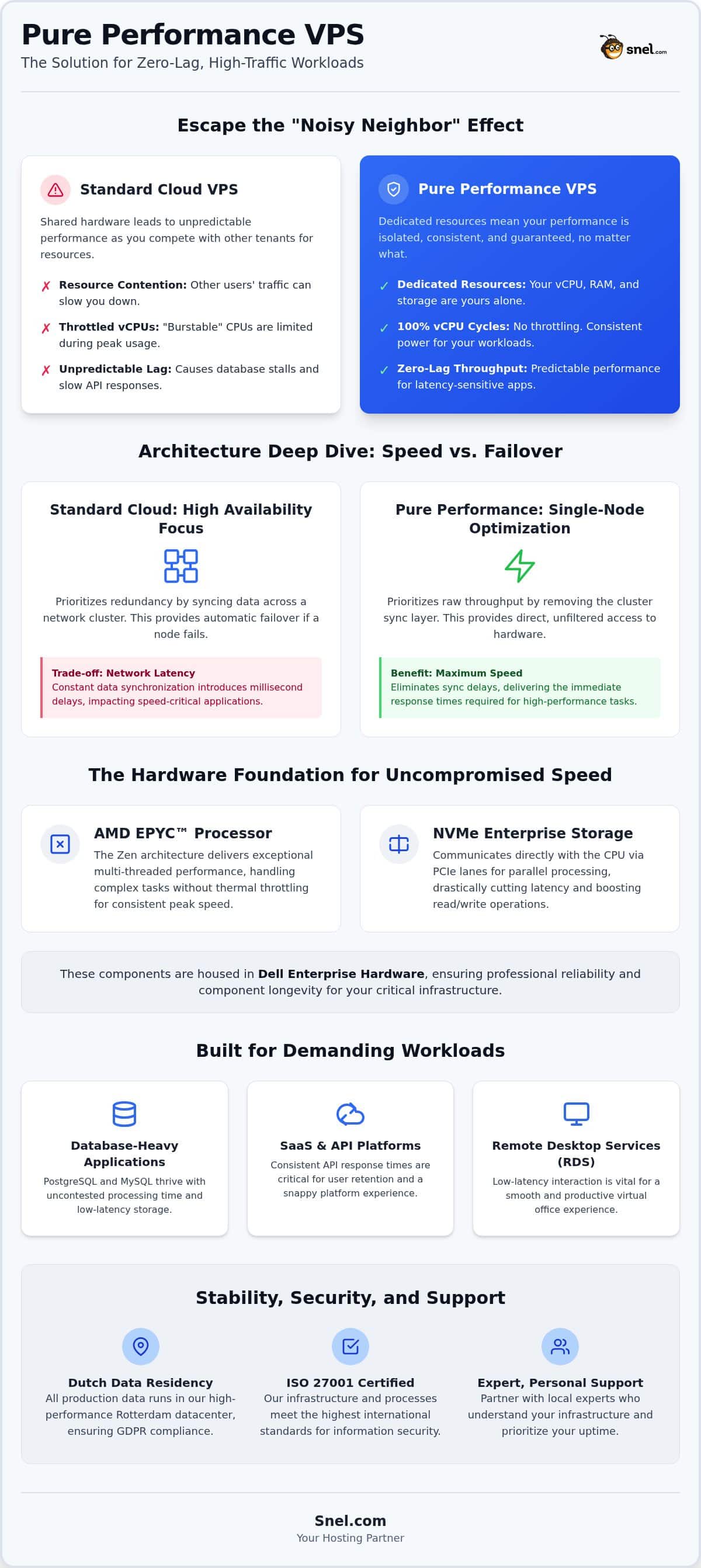
Standard Cloud VPS solutions prioritize redundancy. They sync data across a network cluster. If one node fails, another takes over. While this provides peace of mind, the synchronization introduces network latency. Pure Performance VPS takes a different path by prioritizing single-node optimization. We remove the cluster sync layer to eliminate the millisecond delays that plague speed-critical applications. It’s the ideal choice when your priority is immediate response times rather than distributed failover.
Dedicated Resource Isolation
The “noisy neighbor” effect is the silent killer of database performance. In a typical cloud environment, you use burstable vCPUs. These might be throttled if another tenant on the same host gets busy. We solve this by providing 100% dedicated vCPU cycles. You never compete for processing power. This creates a predictable environment where your CPU throughput remains constant. When evaluating vps vs dedicated server performance, the gap closes significantly because you have guaranteed access to the underlying AMD EPYC silicon. It gives you the reliability of a dedicated machine with the flexibility of a virtualized one.
Hardware-Level Advantages: AMD EPYC and NVMe Storage
Choosing the right hardware is about more than just numbers on a spec sheet. It’s about how those components work together to deliver consistent stability. At Snel.com, we use Dell Enterprise hardware to ensure your infrastructure benefits from component longevity and professional reliability. This solid foundation is what allows a Pure Performance VPS to outpace standard virtual environments that rely on consumer-grade or aging gear.
AMD EPYC™ Processor Throughput
The Zen architecture inside AMD EPYC™ processors is a game-changer for multi-threaded applications. These chips handle complex tasks without the thermal throttling issues that often plague older hardware. For those running high performance vps hosting, this means your server maintains its peak speed even during intense processing cycles. Whether you’re compiling code or running a busy web application, the high core-count efficiency ensures your tasks don’t get stuck in a processing queue.
NVMe Enterprise Storage Lanes
Storage speed often becomes the ultimate bottleneck in modern hosting. While traditional SATA SSDs use serial processing, handling one command at a time, NVMe storage utilizes parallel processing. It communicates directly with the CPU via the PCIe bus, which drastically cuts down on latency. This direct communication path allows for significantly higher random read/write operations compared to older drive standards.
When you pair this storage with high-frequency RAM, database query execution times drop, leading to a much smoother user experience. If you’re unsure which hardware tier fits your specific database needs, our experts are happy to provide a personalized recommendation. This hardware synergy is why our Pure Performance VPS remains a top choice for developers who value raw, uncompromised speed in our Rotterdam datacenter.
Identifying High-Traffic Use Cases for Dedicated Resource Allocation
Standard virtualization works well for basic websites, but complex workloads require a more robust approach. A Pure Performance VPS is specifically built for environments where resource contention isn’t just an inconvenience; it’s a dealbreaker. By providing dedicated vCPU cycles, we ensure that your most demanding applications always have the power they need to function correctly.
- Database-heavy applications: PostgreSQL and MySQL instances thrive when they don’t have to wait for processing time.
- SaaS Platforms: API response times directly impact user retention. Consistent throughput keeps your platform snappy.
- Remote Desktop Services (RDS): Low-latency user interaction is vital for a smooth virtual office experience.
- High-Definition Streaming: Bandwidth-intensive platforms such as Edge IPTV require the stability of dedicated resources to deliver seamless, high-quality video content without interruption.
- Internet Radio Hosting: For broadcasters who require zero-lag audio delivery, ReliaStream provides specialized ShoutCast and IceCast solutions that benefit from high-throughput infrastructure.
This setup allows you to maintain dedicated server levels of performance while benefiting from the cost-efficiency of a virtualized environment. It’s the smart middle ground for growing businesses that need a high-speed Pure Performance VPS.
Transactional and E-commerce Platforms
During high-traffic marketing events, predictable disk I/O is the difference between a completed sale and a bounced customer. Checkout lag often happens when storage can’t keep up with concurrent requests. We combine this raw speed with enterprise-grade reliability to ensure your store stays accessible and fast even during a surge in visitors. Keeping your shop online and responsive is our priority during your most critical sales periods.
Custom Application Development
Developers frequently require specific kernel configurations that restricted environments won’t allow. Our unmanaged servers provide the freedom you need to build exactly how you want. When your needs change, our flexible upgrades path lets you scale individual resources like RAM or storage independently. This ensures your infrastructure grows alongside your codebase without unnecessary overhead.
Strategic Implementation with Snel.com’s Managed Support
Infrastructure throughput depends on the support team standing behind it. Global cloud providers often rely on automated ticketing systems that don’t provide technical clarity quickly. We operate as a hosting partner, offering a direct connection to in-house experts in Rotterdam. This personal approach ensures your high-throughput server isn’t just an entry in a database. By hosting all production data within the Netherlands, we provide a foundation for GDPR compliance and protect your business from the jurisdictional reach of the US Cloud Act.
Reliability is verified through our ISO 27001 certification. This standard ensures rigorous management of sensitive client information. We also prioritize sustainability by using 100% green energy as certified by the Green Web Foundation. Our Rotterdam datacenter operates with a PUE below 1.15 based on our own measurements. This is significantly more efficient than the typical 1.5 to 2.0 range. These facts allow our partners to include high-speed hosting in their corporate sustainability reporting with full transparency.
Managed vs. Unmanaged Performance
Managed services provide a hands-off infrastructure strategy for businesses without a dedicated IT department. Our in-house team handles proactive monitoring and security patching to ensure your environment remains stable. This support model allows you to focus on your core operations while we manage the underlying technical complexities. It’s a professional alternative to self-managed setups where you are responsible for every configuration update.
Security and Compliance Protocols
Data integrity requires a multi-layered defense. We utilize Acronis Cyber Protect to provide AES-256 encrypted backups. These offsite copies are stored in Frankfurt for disaster recovery purposes, but your primary production data never leaves our Rotterdam facility. This structure provides a balanced approach that maintains strict Dutch data residency while ensuring your business can recover quickly from unforeseen events.
Building Your High-Speed Infrastructure Future
Transitioning to a Pure Performance VPS means choosing raw hardware speed over the micro-latency of traditional cloud clusters. You’ve seen how the combination of dedicated AMD EPYC resources and NVMe storage creates a stable environment for your most demanding database and RDS workloads. By moving away from overcommitted resources, you gain the predictable throughput necessary for sustained growth. This architecture ensures your applications stay responsive even during peak traffic events.
Our commitment to your success goes beyond hardware. With a 4.8/5 Google Review rating and ISO 27001 certified security, we provide a reliable foundation for your data in our Rotterdam datacenter. We take pride in our 100% Green Hosting certification, ensuring your performance doesn’t come at the expense of the environment. You don’t have to navigate technical challenges alone when you have a dedicated partner ready to assist you at every step.
Let’s build something fast and reliable together.
Frequently Asked Questions
How does Pure Performance VPS differ from a standard Cloud VPS?
Standard cloud clusters often rely on network-attached storage which can be affected by network congestion. Our performance-optimized nodes use local storage attached directly to the machine, which reduces the time it takes to deploy a new instance. Most servers are online and ready for configuration within 60 seconds of your order. You can choose from the latest versions of AlmaLinux, Debian, or Ubuntu to match your stack.
Can I upgrade from a Pure Performance VPS to a Dedicated Server later?
Moving to an Enterprise Dedicated Server is a strategic step that we manage closely with you. Unlike automated migrations that might break custom configurations, our team works to minimize downtime during the transition. We often help you plan the IP address migration to avoid DNS propagation delays. While virtual servers are instant, dedicated hardware is typically provisioned and tested within 24 business hours to ensure component stability.
Is the vCPU in a Pure Performance plan truly dedicated to my server?
We use KVM (Kernel-based Virtual Machine) technology to enforce strict hardware isolation. This ensures that the host operating system cannot allocate your assigned cycles to background tasks or other tenants. We also perform hardware firmware updates and kernel patches during pre-announced maintenance windows to ensure your resources remain at peak efficiency. This technical transparency is part of our commitment to being an involved hosting partner.
Where is my data physically stored when using Snel.com?
Our Rotterdam facility is protected by multiple layers of physical security, including biometric access controls and constant CCTV monitoring. To ensure your server stays online, we utilize an N+1 power configuration with multiple UPS systems and backup generators. The datacenter is also strategically located outside of flood-prone zones. This provides an extra layer of geographic stability for your production data within the Netherlands.
Do I need technical knowledge to run a Pure Performance VPS?
While unmanaged servers require command-line proficiency, you can simplify management by adding a control panel like Plesk or DirectAdmin. These interfaces automate complex tasks such as DNS management, mailbox creation, and PHP version switching. If you ever lose access to your server, our client area includes a web-based console and a rescue mode. These tools allow you to boot into a temporary environment to fix configuration errors or reset passwords.