
Why should you have to migrate your entire environment just because your application needs a bit more breathing room? Most developers have experienced the headache of a forced upgrade path that requires hours of downtime or requires paying for unused RAM just to unlock a few more vCPUs. It’s a rigid approach that slows your growth and drains your budget. When you choose scalable VPS hosting, you shouldn’t be restricted by fixed plans that don’t reflect your actual workload. We believe your infrastructure should adapt to you, not the other way around.
You probably agree that the best scaling happens behind the scenes without your users ever noticing a flicker. This guide will show you how to implement granular resource scaling to maintain peak performance without the friction of server migrations or vendor lock-in. We’ll walk through the technical steps for zero-downtime resource increases and explain how to maintain strict GDPR compliance using our Rotterdam-based datacenter. It’s time to build a sustainable growth strategy that puts you in total control of every hardware metric.
Key Takeaways
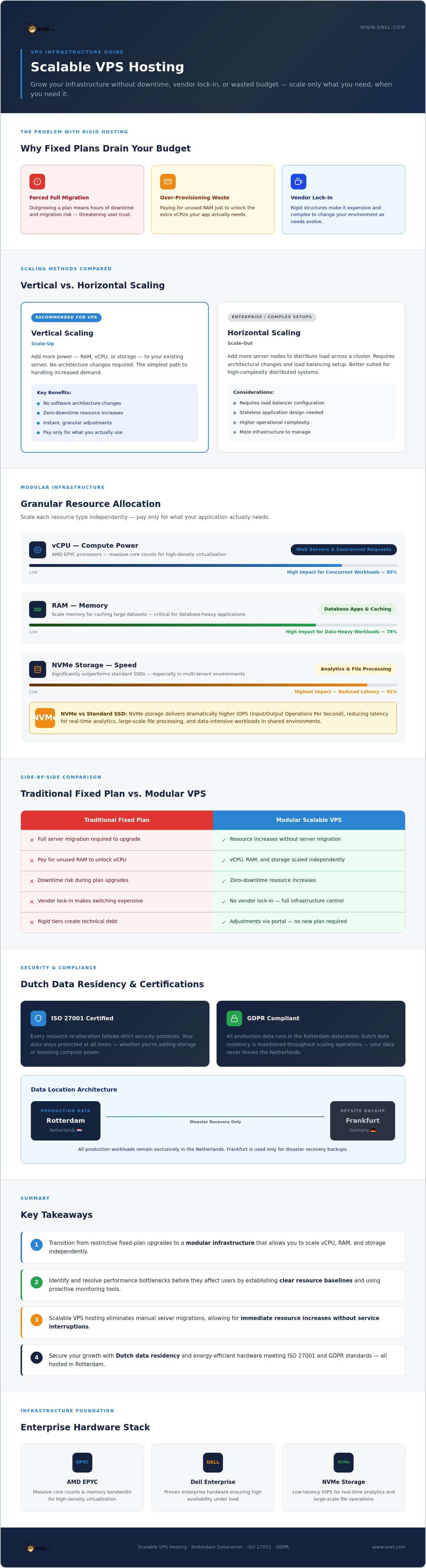
- Transition from restrictive fixed-plan upgrades to a modular infrastructure that allows you to scale vCPU, RAM, and storage independently.
- Identify and resolve performance bottlenecks before they affect your users by establishing clear resource baselines and using proactive monitoring tools.
- Learn how scalable VPS hosting eliminates the need for manual server migrations, allowing for immediate resource increases without service interruptions.
- Secure your application’s growth with Dutch data residency and energy-efficient hardware that meets strict ISO 27001 and GDPR standards.
Defining Scalable VPS Hosting and Its Role in Modern Infrastructure
True scalable VPS hosting functions as a living environment where resources adjust based on your specific workload demands. Unlike traditional hosting that boxes you into rigid tiers, a modular approach allows for independent adjustments to vCPU, RAM, and storage. This flexibility is the hallmark of Infrastructure as a Service (IaaS) maturity, enabling SMEs to operate with the same agility as enterprise level corporations.
Rigid hosting plans frequently lead to over-provisioning. You might find yourself paying for extra RAM you don’t use just to access the additional vCPUs required for a high-traffic period. It’s a waste of budget that adds up quickly. By choosing a partner that offers granular control, you ensure every euro spent directly supports your application performance.
The Problem with Rigid Hosting Architectures
When you outgrow a fixed server plan, the traditional solution is a full migration. This process creates significant technical debt and carries the risk of service interruptions. Dealing with migration downtime isn’t just a technical hurdle; it’s a threat to user trust. Additionally, many providers use these rigid structures to create vendor lock-in, making it difficult and expensive to move your environment as your needs change.
Vertical vs. Horizontal Scaling: A Brief Comparison
Understanding your growth path requires a clear distinction between two primary methods:
- Vertical Scaling (Scale-Up): This involves adding more power, such as RAM or vCPU, to your existing server node. It’s the most straightforward way to handle increased resource demands without changing your software architecture.
- Horizontal Scaling (Scale-Out): This strategy adds more nodes to your infrastructure, distributing the load across a cluster of servers.
Our infrastructure is designed to support seamless vertical growth, ensuring your scalable VPS hosting experience remains smooth as your user base expands.
The Mechanics of Granular Resource Allocation: vCPU, RAM, and Storage Modularity
Building a robust infrastructure requires hardware that handles high-density virtualization without performance degradation. We utilize AMD EPYC processors and Dell Enterprise hardware to ensure your environment remains highly responsive even under load. These chips provide the massive core counts and memory bandwidth needed for modern virtualization. While some providers offer fixed tiers, our modular approach lets you increase vCPU, RAM, and storage independently. This ensures you only pay for what your application actually uses at any given moment.
Security remains a priority during these transitions. Our ISO 27001 certification guarantees that every resource re-allocation follows strict security protocols. Whether you’re adding storage or boosting compute power, your data remains protected within our Rotterdam datacenter. This modularity is a core component of scalable VPS hosting, providing peace of mind as you grow your business without compromising on data residency requirements.
Independent Scaling of vCPU and RAM
Application needs are rarely uniform across different software stacks. A database-heavy app often requires significant RAM for caching large datasets, while a web server might require more vCPU to handle high volumes of concurrent requests. Our Pure Performance VPS management portal makes these adjustments simple and intuitive. You can adjust your specs with a few clicks, avoiding the cost of an entirely new plan just to fix a single resource constraint that might be temporary.
NVMe Storage Modularity and Performance
Storage speed is a critical factor in overall application performance. NVMe storage throughput significantly outperforms standard SSDs, especially in multi-tenant environments where IOPS (Input/Output Operations Per Second) are shared among users. This technology reduces latency for data-intensive tasks like real-time analytics or large-scale file processing. For those scaling sensitive data environments, adding Acronis Cyber Protect provides an additional layer of security and backup that integrates seamlessly with your scaled storage.
Strategic Implementation: Planning Your Scaling Journey Without Service Interruption
Executing a resource upgrade is a technical process that requires a clear strategy to prevent service interruptions. Before making any changes, you should establish a performance baseline by monitoring your environment for approximately 14 days. This data provides a technical roadmap for your growth, allowing you to distinguish between temporary traffic spikes and a genuine need for more permanent resources. This proactive approach prevents the architectural inefficiencies often associated with rushed infrastructure changes, ensuring your scalable VPS hosting environment supports your application without unexpected performance dips.
Monitoring for Infrastructure Performance Constraints
Effective scaling relies on tracking specific hardware metrics that indicate when a server is reaching its capacity. You should monitor CPU steal time to ensure other virtual instances aren’t impacting your processing power, along with RAM swap usage which indicates when your physical memory is exhausted. High disk I/O wait times often suggest that your storage throughput is insufficient for your database queries. Our Rotterdam based team uses these metrics to provide proactive advice on resource allocation, allowing for a controlled response rather than a reactive emergency.
Avoiding Downtime During Resource Upgrades
Modern hypervisors allow for the hot-plugging of vCPU and RAM, which means resources can often be added to a running server without a full restart. When a reboot is necessary for the operating system to recognize the new allocation, our Dell Enterprise hardware typically completes the process in under 60 seconds. If you use a Managed VPS, our team handles this configuration and ensures daily backups are verified before the upgrade begins. For users whose requirements eventually exceed the limits of virtualization, a fully managed dedicated server provides a path for further expansion with isolated hardware and higher throughput.
Snel.com: Human-Centric Scalable Infrastructure Hosted in the Netherlands
Scaling your digital footprint shouldn’t mean sacrificing personal connection for automated tickets. We’ve built our infrastructure to be a dedicated ally for your business growth. Our approach combines high-performance hardware with a genuine commitment to sustainability and transparency. Every server in our Rotterdam datacenter runs on 100% green energy, verified by the Green Web Foundation. We maintain a Power Usage Effectiveness (PUE) below 1.15, ensuring your scalable VPS hosting is as environmentally responsible as it is powerful. Innovations from companies like Ethernetics are helping the industry tackle challenges like power stranding to further improve these efficiency metrics.
Flexibility is the backbone of our service model. Unlike providers that lock you into long-term commitments, we offer monthly cancellable contracts. This allows you to adjust your resources or pivot your strategy without financial penalties. It’s a no-nonsense partnership designed to support your success at every stage of your journey.
For many SMEs and SaaS builders, knowing exactly where data lives is a non-negotiable requirement. We ensure all production data remains strictly within the Netherlands, providing full compliance with GDPR and Dutch data residency laws. While we store offsite backups in Frankfurt, these are used exclusively for disaster recovery purposes. Our ISO 27001 certification provides an additional layer of verified security for your infrastructure.
Expert Support for Complex Scaling
When you face a technical challenge, you don’t want to fight through layers of automated bots. Our in-house experts are ready to assist with your scalable VPS hosting needs at any level, providing the “neighborly expert” guidance you need during critical growth phases. We answer your first message with technical depth and a helpful attitude. You can explore scalable VPS options today to see how our human-centric approach makes a difference in your day-to-day operations.
Future-Proof Your Growth with Flexible Infrastructure
Building a sustainable infrastructure strategy means moving away from the “one size fits all” mentality that often leads to wasted budget and migration headaches. By focusing on modular resource allocation, you can scale your application with precision, adding power only where it’s needed. This granular approach to scalable VPS hosting ensures that your growth remains efficient and cost-effective. You’ve seen how keeping your production data in our Rotterdam-based datacenter provides both speed and strict GDPR compliance.
Our commitment to reliability is backed by ISO 27001 certified security and an environmentally conscious infrastructure with a PUE below 1.15. You don’t have to navigate these technical transitions alone. Our 24/7 in-house expert support is always ready to provide a steady hand, ensuring your journey from a single node to a complex cluster is smooth and secure. We’re here to help you build something that lasts.
Frequently Asked Questions
Can I scale my VPS resources independently without upgrading to a larger plan?
You can absolutely scale your resources independently without the need to switch to a pre-defined larger plan. This modular approach allows you to fine-tune your environment based on specific application needs. If your database needs more memory but your compute usage is low, you can simply add RAM. This ensures you only pay for the specific hardware you use rather than a bundled package that includes unused resources.
Is there downtime involved when I increase my vCPU or RAM?
Most resource increases are handled without significant downtime through a process called hot-plugging. This technology allows the hypervisor to inject additional vCPU cores or RAM directly into your running instance. While some operating system configurations might require a quick reboot to recognize the new hardware, our enterprise Dell hardware ensures these restarts happen in seconds. This allows you to maintain service availability while your infrastructure grows to meet demand.
How does scalable VPS hosting differ from a dedicated server?
This type of scalable VPS hosting uses virtualization to provide flexible, modular resource blocks on a shared physical host. It’s ideal for businesses that need to make quick, incremental adjustments to their capacity. In contrast, a dedicated server provides you with the entire physical machine for absolute resource isolation. While dedicated servers offer higher raw throughput, they lack the same instant, granular scaling flexibility found in a virtualized environment.
Where is my data stored when I use a scalable VPS in the Netherlands?
All your production data is stored on enterprise grade hardware within our Rotterdam datacenter. We maintain strict Dutch data residency to ensure full GDPR compliance for your business operations. For disaster recovery purposes, we store offsite backups in Frankfurt, Germany. This setup ensures that while your live environment stays local, your backups are protected in a separate geographic region within the European Union for maximum reliability and safety.
Can I scale down my resources if my traffic decreases?
You have the flexibility to adjust your infrastructure as your business needs change. Since our plans are cancellable monthly, you aren’t locked into high-capacity hardware if your traffic levels drop. While scaling down storage requires careful data management due to file system partitions, adjusting vCPU and RAM is straightforward. This adaptability helps you manage costs effectively, ensuring your hosting budget aligns perfectly with your actual performance requirements throughout the year.