


Did you know that the first cyberattack on a new VPS can occur within just 22 minutes of going live? For many developers and SMEs, that’s a chilling thought. When deciding between a managed vs unmanaged vps, you’re looking for a balance between power and peace of mind. You want the freedom of dedicated resources, but you don’t want the midnight alerts or the constant hunt for security patches. It’s a common dilemma. You need a setup that scales with your growth rather than one that adds to your daily technical debt.
Choosing the right strategy isn’t just a technical decision; it’s about where you place your operational risk. We’ll help you navigate this choice by comparing hands-on control against expert-led management. You’ll learn exactly who handles what, from GDPR compliance to hardware performance. We’ll also explore how our Rotterdam-based infrastructure ensures Dutch reliability while keeping your data secure. By the end, you’ll know how to achieve high performance without the need to babysit your hardware 24/7.
Key Takeaways
- Identify the specific division of labor between your team and our experts to ensure your server’s security and maintenance are always covered.
- Learn why hosting production data in our Rotterdam datacenter is essential for maintaining ISO 27001 standards and GDPR compliance.
- Analyze how your choice of infrastructure affects your team’s bandwidth and the accumulation of technical debt as your business scales.
- Use our comparison of managed vs unmanaged VPS to decide whether you prioritize hands-on root access or the reliability of expert-led management.
Defining the Managed vs Unmanaged VPS Responsibility Model
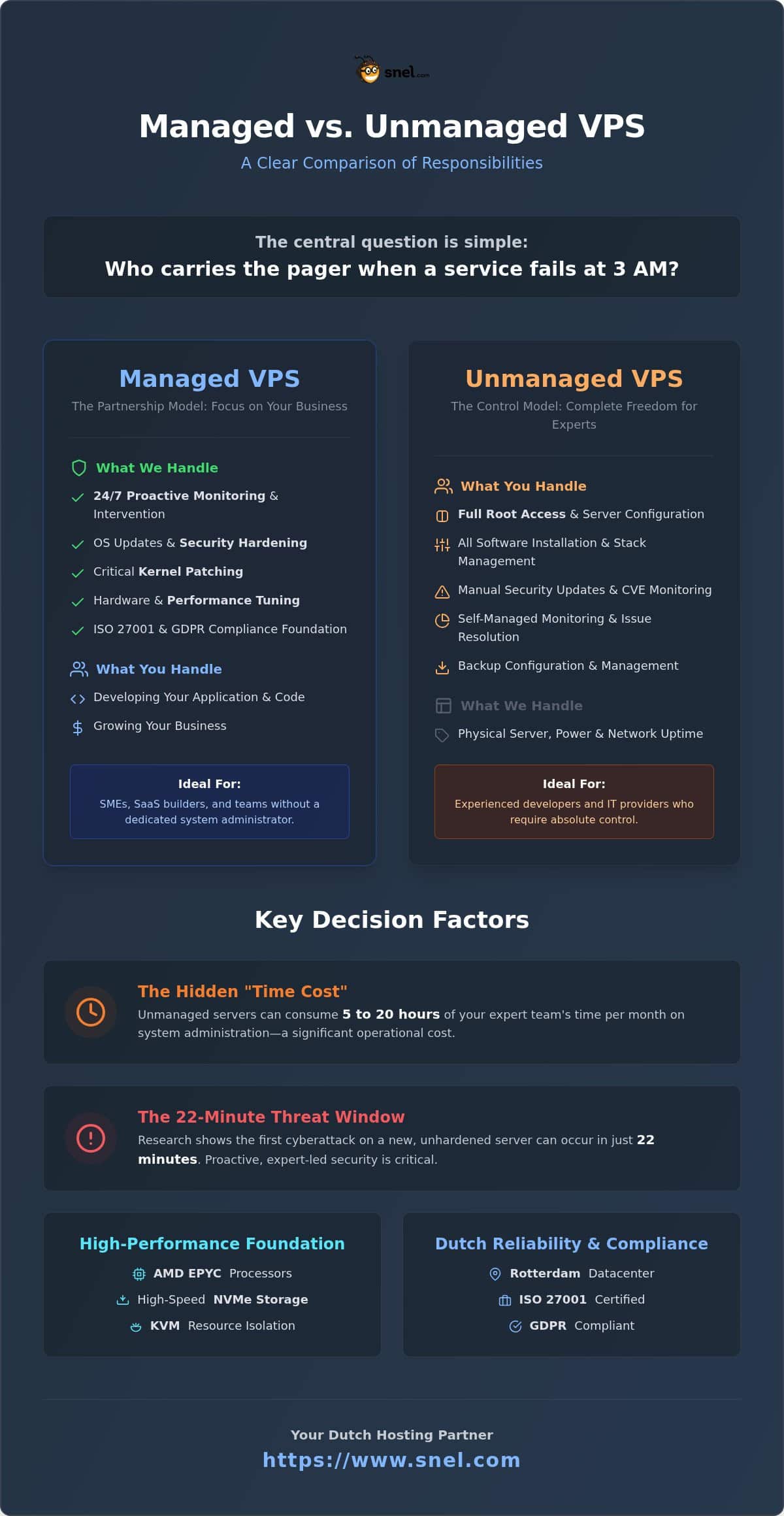
The central question of the managed vs unmanaged vps debate comes down to a single scenario: who carries the pager when a service fails at 3 AM? In 2026, virtual private servers remain the standard for scalable business applications because they offer a reliable middle ground between shared hosting and dedicated hardware. However, your infrastructure strategy depends entirely on where you want the line of responsibility to be drawn. It’s about deciding whether you want to be a system administrator or a business owner.
The Managed VPS Advantage: Focus on Your Business
A managed VPS is a collaborative partnership. We take care of the technical heavy lifting, including operating system updates, security hardening, and proactive 24/7 monitoring. This model is ideal for SMEs and SaaS builders who don’t have a dedicated system administrator on staff. Instead of worrying about kernel patches or tracking CVEs, you can focus on building your product. Our team ensures your environment meets ISO 27001 standards, providing a stable foundation that grows with you without adding to your technical debt. You get the expertise of a full IT department without the overhead.
The Unmanaged VPS Choice: Total Control for Experts
Unmanaged VPS is raw compute power without a management layer. It’s designed for developers and IT service providers who require full root access and the freedom to custom-build their entire software stack from the ground up. While this option offers lower direct monthly costs, it carries a significant “time cost” for the user. You’re responsible for every aspect of the server’s health, from the initial configuration to ongoing security. It’s a high-performance solution for those who have the expertise to manage their own uptime and security protocols.
- Full Root Access: You have complete authority over the server environment and configurations.
- Software Freedom: Install any OS distribution or specialized stack without any interference.
- Manual Maintenance: You’re the one applying security updates and managing backups.
This approach gives you total control, but it also means you’re the first line of defense when things go wrong.
Security, Maintenance, and Performance Benchmarks
Security isn’t a “set and forget” task. When evaluating managed vs unmanaged vps, the maintenance workload is the biggest differentiator. Managed servers thrive under professional security hardening and ISO 27001 standards. We proactively track vulnerabilities and apply kernel patches to keep your environment resilient. In contrast, unmanaged users must manually monitor CVE databases. This is critical since research shows the first cyberattack on a new server can occur within just 22 minutes. Both models benefit from our Acronis Cyber Protect integration, ensuring automated backups are always ready for disaster recovery in our Rotterdam datacenter.
Hardware Optimization: AMD EPYC and NVMe Throughput
Raw hardware is only as good as its configuration. Our Pure Performance VPS uses AMD EPYC processors and NVMe storage to deliver high IOPS and low latency. These resources need professional tuning to reach their full potential. We prioritize:
- Resource Isolation: Strict KVM virtualization ensures “noisy neighbors” don’t steal your CPU cycles.
- Throughput Optimization: NVMe configurations are tuned for consistent data transfer speeds.
- Scalable Architecture: Infrastructure that supports growth without performance degradation.
If you aren’t sure which hardware profile fits your specific application, feel free to reach out for a personal recommendation from our team.
Uptime and Monitoring Protocols
Uptime is the lifeblood of your digital presence. Choosing between managed vs unmanaged vps depends on your team’s capacity for manual maintenance. We back our infrastructure with a 100% uptime SLA, but the level of monitoring varies by your chosen strategy. Managed services include proactive 24/7 monitoring where our in-house experts intervene before a service failure impacts your users. With an unmanaged setup, monitoring is typically reactive. You identify the issue and resolve it yourself using your root access. It’s the difference between a partner who watches your back and a provider who simply keeps the server powered on.
Decision Framework: Expertise, Time, and Growth
Choosing between managed vs unmanaged vps isn’t just about your current skill set. It’s about your future capacity. An unmanaged VPS often carries a hidden cost. Industry data suggests server administration can consume between 5 and 20 hours per month. When you calculate the hourly rate of your senior developers, that “low-cost” server suddenly looks quite expensive. This is technical debt in its purest form. If your team spends their Tuesday morning troubleshooting an OS-level conflict instead of shipping new features, your infrastructure is slowing you down. You’re trading your most valuable asset, your time, for a lower monthly invoice.
When to Choose Unmanaged
Unmanaged servers are perfect for high-volume testing environments or specialized projects. If you need to compile a custom kernel or deploy a niche Linux distribution that isn’t widely supported, you need root-level freedom. It’s the right choice for budget-conscious labs where technical expertise is abundant and downtime doesn’t impact your bottom line. You get a raw canvas to experiment without any management layer getting in your way. For many developers, this hands-on control is the primary driver for their infrastructure strategy.
When Managed is Non-Negotiable
For production environments like e-commerce stores, CRMs, or client-facing SaaS apps, managed services are essential. These applications require documented security protocols and guaranteed uptime. As your user base grows, you can upgrade your resources without the stress of manual migration or downtime. Many SaaS builders follow a specific path: they start unmanaged during the early dev stages and migrate to a managed vs unmanaged vps strategy once they have paying customers. This shift ensures they can scale without their infrastructure becoming a full-time babysitting job. It allows you to maintain Dutch reliability for your clients while your team remains focused on the core product.
Snel.com: Your Dutch Hosting Partner in Rotterdam
At Snel.com, we believe your hosting should feel like a partnership rather than a transaction. Whether you’re weighing managed vs unmanaged vps, the infrastructure behind your choice matters. All our production data lives in our own Rotterdam datacenter. We don’t use outsourced call centers; instead, you get direct access to our in-house enthusiasts. Our facility is certified by the Green Web Foundation and operates with a PUE under 1.15, meaning your digital growth doesn’t come at the expense of the environment. We also offer monthly cancellable plans. We want you to stay because you’re happy, not because you’re locked in.
The Snel.com Difference: Personal and Professional
Our independent ownership allows us to prioritize individual client success over corporate quarterly reports. We’re a close-knit team that cares about every single server. You’ll work with technicians who have deep experience in complex environments, including those detailed in our fully managed dedicated server guide. This hands-on approach ensures that if a hardware issue arises on your unmanaged server, you aren’t just another ticket in a massive queue. We combine technical proficiency with a neighborly expert vibe.
Compliance and Security in the Netherlands
Data residency is a critical factor often overlooked in the managed vs unmanaged vps discussion. By keeping your data strictly within the Netherlands, you gain full GDPR compliance and protection from the US Cloud Act. This legal shield is vital for businesses handling sensitive European user data. We include ISO 27001 certification as a standard foundation for all our services. It’s not an add-on; it’s our commitment to your security. You get the stability of a world-class facility with the personal touch of a local specialist who knows your name.
Secure Your Infrastructure Strategy for 2026
Choosing between managed vs unmanaged vps is a decision about where your team should focus its energy. If you need total root access for custom development, unmanaged infrastructure offers the freedom you require. However, for those who want to eliminate technical debt and focus on growth, our managed services provide a stable, ISO 27001 certified foundation. Your production data stays secure in our Rotterdam datacenter, protected by Dutch privacy laws and our commitment to 100% green energy.
We’re proud of our 4.8/5 Google Review rating and our dedicated team of in-house experts available 24/7 to assist you. Whether you prioritize hands-on control or expert-led maintenance, we have the hardware and the personal service to back you up. It’s time to build your next project on a platform that values reliability as much as you do.
We look forward to helping you find the right fit for your business with our signature Dutch reliability.
Frequently Asked Questions
Can I switch from an Unmanaged VPS to a Managed VPS later?
Yes, you can upgrade to a managed plan at any time. However, this usually involves a migration process because the management layer needs to be installed on a fresh OS. Our team can help you plan this transition to minimize downtime. It’s a common path for growing SaaS builders who started with raw compute but now need professional oversight to scale safely and reliably.
Does Managed VPS include support for my specific website code or application?
We handle the server infrastructure, operating system, and control panel, but we don’t debug custom application code or third-party plugins. Our managed vs unmanaged vps comparison focuses on the server environment itself. We ensure your PHP, MySQL, and web server are optimized and secure. If your application has specific server-side requirements, our in-house experts can help configure the environment to support those dependencies perfectly without adding technical debt.
Is the hardware different between Managed and Unmanaged VPS plans?
No, both plans utilize the same high-performance infrastructure in our Rotterdam datacenter. Whether you choose a managed vs unmanaged vps, you get access to AMD EPYC processors and NVMe storage. We don’t throttle unmanaged plans or use second-tier hardware. The difference lies entirely in the service layer and who is responsible for the maintenance, security hardening, and proactive monitoring of that underlying hardware.
Do I get root access with a Managed VPS?
Root access is typically restricted on managed plans to ensure the stability and security of the environment we’re maintaining for you. Since we carry the responsibility for uptime and ISO 27001 compliance, we manage the core system configurations. If you require specific administrative changes, our team handles them upon request. If you absolutely need full root access for custom kernels, an unmanaged VPS is the better choice.
How does Dutch data residency protect my business compared to US-based hosts?
Hosting in the Netherlands provides a legal shield against the US Cloud Act, which allows US authorities to access data regardless of where it’s stored. All our production data stays in Rotterdam. This ensures strict GDPR compliance and superior privacy protection. For businesses handling European user data, this residency is a non-negotiable security feature that impersonal global giants simply cannot offer with the same level of legal certainty.