

Why does your server feel unresponsive the moment your visitor count increases? You’ve likely experienced the frustration of unpredictable CPU steal time or database queries that slow down despite paying for premium tiers. It’s a common challenge for those managing a vps for high traffic websites when the hardware specifications remain unclear. We understand that for your SaaS or growing business, every millisecond of delay impacts your user experience and your business results.
You deserve complete clarity regarding your digital infrastructure. This guide examines the 2026 technical standards that differentiate high-performance environments from basic cloud instances. We’ll explain how dedicated vCPU allocation and NVMe throughput standards ensure your applications remain stable during demand peaks. We’ll also explore how modern hardware and transparent Dutch infrastructure in our state-of-the-art datacenters provide the reliable foundation your project needs to succeed. It’s time to move past vague marketing claims and focus on the concrete details that drive real-world performance.
Key Takeaways
- Understand how the combination of AMD EPYC processors and NVMe storage provides the necessary throughput for database-heavy production sites.
- Discover why dedicated vCPU allocation is essential for a reliable vps for high traffic websites to maintain consistent performance during visitor surges.
- Learn how to identify and eliminate the “noisy neighbor” effect through the use of KVM virtualization and guaranteed resource isolation.
- Explore the legal and performance advantages of Dutch data residency, ensuring your infrastructure stays compliant with GDPR and AVG regulations.
- Find out how to select a hosting partner that balances high-performance hardware with 100% green energy and direct access to human experts.
Defining High Performance VPS Hosting in 2026
High performance hosting isn’t just about big numbers on a pricing page. In 2026, a true high performance VPS is defined by a virtualized environment where resource availability is guaranteed and latency is kept to an absolute minimum. Many standard cloud instances rely on burstable models. These work fine for small blogs, but they often fail when you’re managing a vps for high traffic websites that requires steady, heavy-duty processing power. You need to know that the resources you pay for are actually sitting there, ready to work.
The real difference lies in the underlying architecture. While raw CPU frequency used to be the primary metric, it’s now secondary to factors like L3 cache allocation and I/O wait times. If your processor is fast but it’s constantly waiting for data from the storage layer, that speed is wasted. High performance tiers focus on eliminating these bottlenecks through hardware-level transparency. This clarity gives you the confidence that your infrastructure won’t buckle during a marketing campaign or a sudden viral surge. If you are preparing for such high-traffic events, you can also check out Shrtn.Ink to quickly shorten and manage your links without the need for registration.
The Shift from Shared to Dedicated vCPU
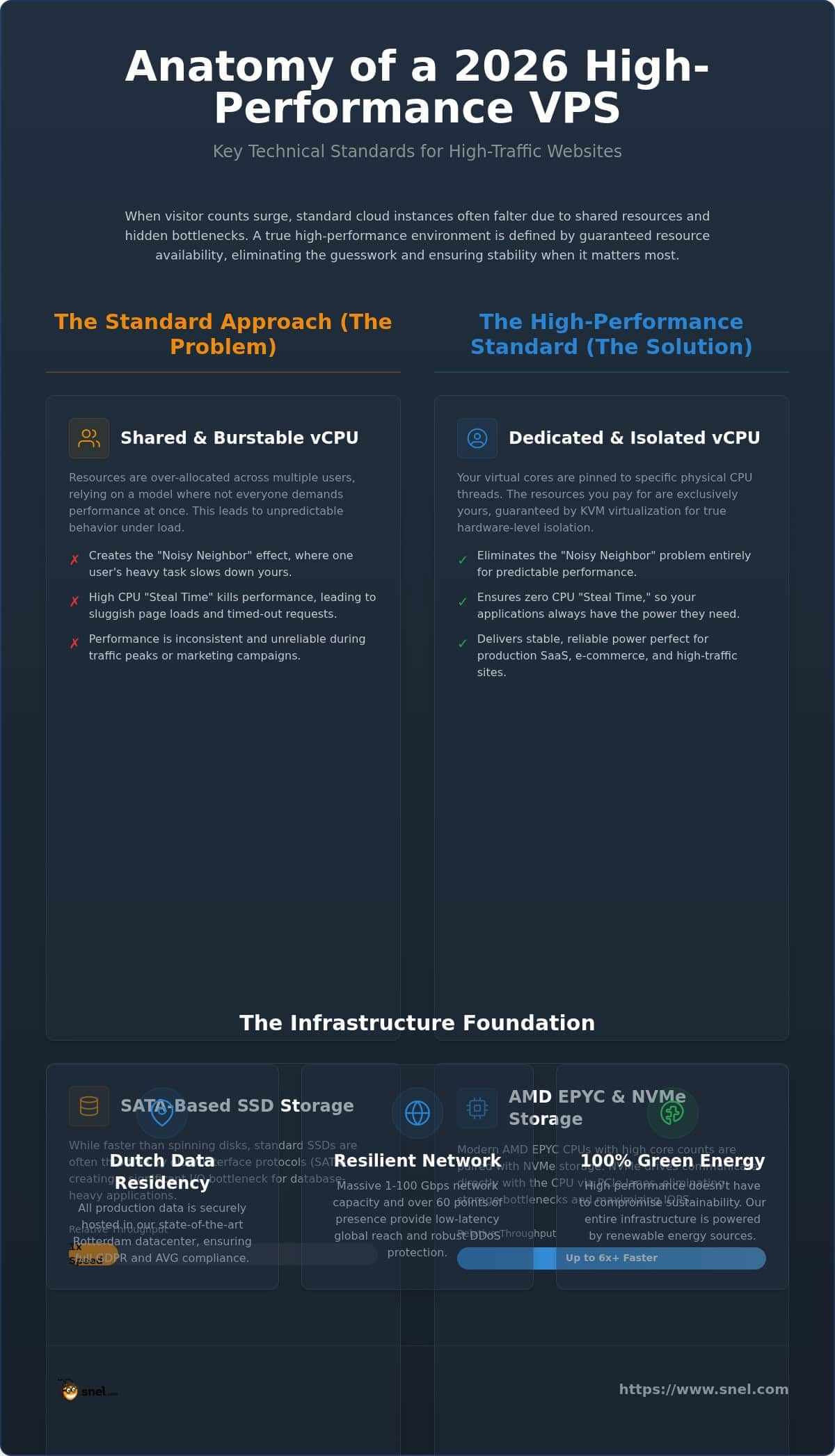
Hypervisors act as the traffic police for server resources. In a standard setup, multiple virtual machines often share the same physical CPU threads. If one “noisy neighbor” starts a heavy task, your application feels the squeeze. This is measured as steal time. For a vps for high traffic websites, steal time is a performance killer that leads to sluggish page loads and timed-out requests. Dedicated vCPU allocation solves this by pinning your virtual cores to specific physical threads on high-end processors. This ensures your CPU cycles are yours and yours alone.
Performance Benchmarks vs. Real-World Utility
It’s easy to get caught up in Geekbench scores. While they provide a useful snapshot of raw power, they don’t tell the whole story of server reliability under a sustained 24-hour load. Real-world utility depends on how well the environment handles resource isolation over time. Pure Performance VPS environments are built specifically to prioritize this isolation. This ensures that your database queries and application logic run at peak speed regardless of what other users on the physical host are doing.
Hardware Foundations: AMD EPYC and NVMe Storage
High performance isn’t just a label; it’s a direct result of the silicon and storage inside the rack. We use AMD EPYC processors because they excel at handling the multi-threaded demands of modern enterprise applications. When you’re running a vps for high traffic websites, your server needs to process thousands of concurrent requests without breaking a sweat. AMD’s architecture provides the high core counts and massive L3 cache required to keep your complex scripts and backend processes running smoothly. This hardware sits in our Rotterdam datacenter, where we maintain full control over the infrastructure quality.
This processing power is paired with NVMe storage to eliminate traditional bottlenecks. While standard SATA SSDs were a huge leap over spinning disks, they’re still throttled by older interface protocols. NVMe drives talk directly to the CPU via PCIe lanes, offering throughput that can be up to six times faster than standard SSDs. This ensures your data-heavy site never waits on the disk to catch up, even during peak traffic hours.
Storage Throughput and IOPS
IOPS stands for Input/Output Operations Per Second. It’s the heartbeat of any SaaS application or database-heavy platform. High IOPS means your server can handle more simultaneous reads and writes. This is critical when hundreds of users are interacting with your platform at once. By using NVMe, we drastically reduce application latency. Your site feels snappy and instantaneous to the end user, which is a major factor in visitor retention.
Network Resilience and Latency
A fast server is useless if the network can’t deliver data to your visitors. Our infrastructure supports 1-100 Gbps network capacity, providing massive headroom for data-intensive operations. We utilize over 60 points of presence (POPs) to optimize global reach, yet all production data stays strictly within the Netherlands for compliance. For a deeper look at how we stay online during attacks, see our DDoS Protected VPS Netherlands guide. If you’re unsure which hardware configuration fits your specific traffic patterns, you can always reach out to our team for a friendly chat.
Eliminating the Noisy Neighbor Problem
The noisy neighbor effect occurs in multi-tenant environments when one virtual machine consumes excessive resources, causing performance issues for others on the same host. For a vps for high traffic websites, this results in unpredictable latency and processing delays that frustrate users. You shouldn’t have to deal with performance dips caused by someone else’s workload. While some believe all virtual hosting is inherently unstable due to resource sharing, proper architectural isolation proves otherwise.
We implement KVM virtualization to create strict hardware-level resource boundaries. This technology ensures your allocated RAM and CPU cores are physically reserved for your exclusive use. Unlike older virtualization methods that often rely on aggressive overprovisioning, our approach prioritizes your stability. Our ISO 27001 certification serves as a formal guarantee of this operational integrity, verifying that we follow rigorous standards to keep your environment secure and stable.
Hypervisor Isolation Techniques
The hypervisor acts as a gatekeeper between your data and the physical hardware. By owning our Rotterdam datacenter, we manage the hardware-to-software ratio with absolute precision to avoid overcrowding our racks. This direct control allows us to enforce strict resource limits at the source, ensuring that unexpected traffic spikes from other users never interfere with your application’s responsiveness.
Maintaining Performance Consistency
Maintaining peak performance requires constant vigilance beyond the initial setup. Our 24/7 monitoring identifies potential resource spikes before they can impact your visitors. Selecting a robust, enterprise-grade operating system like an AlmaLinux VPS adds another layer of stability to your stack. It’s designed specifically for production workloads that require consistent uptime and security.
Selecting a High Performance VPS Partner
Selecting a hosting partner in the Netherlands requires a focus on operational transparency and local expertise. While raw hardware specs are vital, the physical residency of your data determines your compliance with GDPR and AVG. By hosting in our Rotterdam facility, you ensure that your production data remains under Dutch jurisdiction, avoiding the legal complexities of the Cloud Act. Snel.com provides a personal alternative to impersonal global providers, giving you direct access to in-house engineers rather than interacting with automated chat systems.
Environmental efficiency is a key indicator of a well-managed datacenter. Our facility maintains a Power Usage Effectiveness (PUE) below 1.15, which significantly reduces the energy overhead required for cooling. This technical efficiency doesn’t just lower environmental impact; it reflects a modern infrastructure designed for the high-density requirements of a vps for high traffic websites. When your provider prioritizes efficient cooling and 100% green energy, it demonstrates a long-term investment in hardware health and reliability.
Managed vs. Unmanaged Performance
The choice between managed and unmanaged hosting depends on your team’s technical focus. Unmanaged tiers provide full root access for developers who want total control over their environment. Conversely, a managed setup allows our team to handle security hardening and OS updates, letting you focus entirely on your application logic. For those whose requirements have expanded beyond virtualized resources, our Fully Managed Dedicated Server Buying Guide provides a strategic framework for transitioning to bare metal.
Scalability without Vendor Lock-in
Building Your Infrastructure for a High-Growth Future
Your infrastructure is the silent engine behind your digital success. We’ve seen that true high performance isn’t just about raw speed; it’s about the architectural choices that ensure reliability when it matters most. By combining the multi-threaded power of AMD EPYC processors with the rapid throughput of NVMe storage, you create a stable foundation for any vps for high traffic websites. You’re not just buying server space; you’re securing a partner for your business growth.
Choosing a partner who prioritizes hardware transparency and Dutch data residency means you’re investing in long-term security. Our ISO 27001 certification and 100% green energy infrastructure reflect a commitment to professional standards and environmental responsibility. We’re proud of our 4.8/5 Google Review rating because it shows that our focus on personal, human-to-human service truly makes a difference. You don’t have to navigate these technical complexities alone.
Let’s work together to build a hosting environment that stays fast, secure, and sustainable for years to come. We’re ready to help you take the next step.
Frequently Asked Questions
What is the difference between shared and dedicated vCPU in VPS hosting?
Dedicated vCPU allocation ensures that your virtual processor cores are pinned to specific physical threads on the host server. In a shared environment, multiple users fight for the same CPU cycles, which often leads to “steal time” and sluggish performance. Choosing dedicated resources is the most reliable way to manage a vps for high traffic websites, as it guarantees your processing power is always available when you need it.
How does NVMe storage improve high performance VPS hosting speeds?
NVMe storage uses the PCIe bus to communicate directly with the CPU, bypassing the bottlenecks found in older SATA protocols. This architecture allows for significantly higher IOPS and lower latency for your applications. Your database queries will execute much faster, and your visitors will notice a snappier, more responsive experience even during peak traffic periods.
Why is a Netherlands-based datacenter important for my VPS performance?
Hosting your data in a Rotterdam-based datacenter provides the lowest possible latency for your European visitors. Physical distance matters in networking; the closer your server is to your audience, the faster the data arrives. Additionally, a Dutch location ensures your business stays compliant with strict GDPR and AVG regulations, keeping your production data within a secure and transparent legal jurisdiction.
What does a PUE of 1.15 mean for my server infrastructure?
PUE, or Power Usage Effectiveness, measures how much energy is used by the computing equipment versus cooling and other overhead. A score of 1.15 is exceptionally efficient, meaning nearly all the power entering the facility goes directly to running your servers. This efficiency indicates a modern infrastructure design that reduces hardware stress from heat and contributes to a more sustainable hosting environment.
Can I upgrade from a VPS to a dedicated server without downtime?
Upgrading to a dedicated server involves moving your data to a completely different physical machine, which requires a planned migration. While this isn’t an instantaneous “one-click” process like scaling up a VPS, our expert team handles the technical heavy lifting to minimize any impact on your operations. We work with you to ensure your transition to more powerful hardware is as smooth and reliable as possible.