


What Defines High-Performance VPS in Europe?
In today's digital landscape, the term "high performance" is often used, but its true meaning extends far beyond basic speed tests. For businesses operating in or serving the European market, a high-performance VPS is a combination of dedicated resources, strategic location, and modern architecture. It’s the difference between an environment that merely runs and one that consistently delivers a fast, reliable experience for your users.
This level of performance is built on several key pillars:
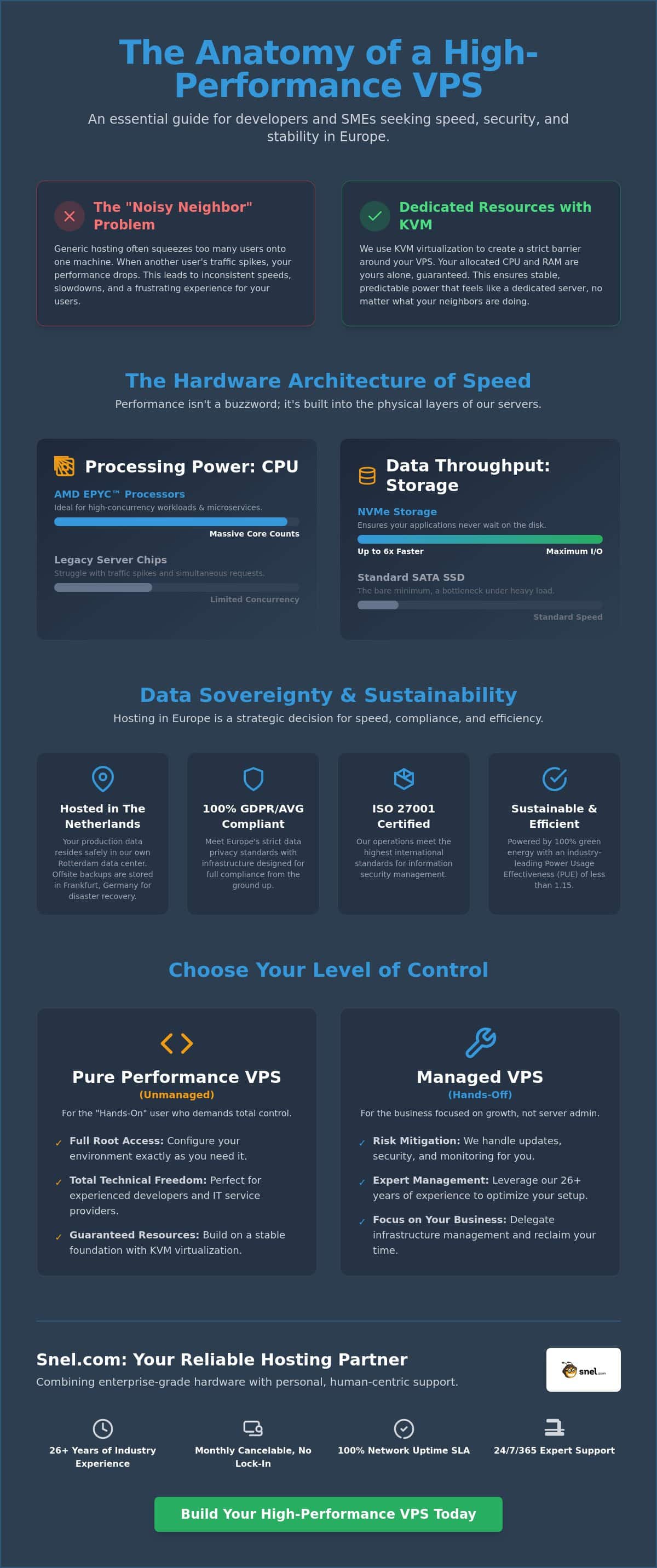
- Dedicated Resource Allocation: Unlike traditional shared hosting where resources are distributed among many users, a true high-performance environment uses KVM virtualization to guarantee that your allocated CPU, RAM, and storage are yours alone. This eliminates the risk of performance degradation caused by other users on the same physical server.
- Strategic European Location: Hosting your infrastructure within Europe is crucial for two reasons: low latency for your user base and straightforward compliance with the General Data Protection Regulation (GDPR). Proximity to your audience significantly reduces data travel time, leading to faster load times and a better user experience.
- Modern Storage Technology: As applications become more complex and data-intensive, standard SSD storage is no longer sufficient. High-speed NVMe (Non-Volatile Memory Express) storage is now the baseline for any serious performance-oriented server, offering multiple times the throughput for database queries and file operations.
- Value-Driven Infrastructure: The focus for growing businesses has shifted from finding the cheapest hosting option to investing in value. This means choosing infrastructure that ensures business continuity, protects customer data, and can scale predictably without requiring a complete and costly migration.
The Latency Advantage: Why Proximity Matters
Latency is the delay between a user's request and the server's response, and it's a critical factor in user satisfaction. For applications requiring real-time interaction, such as e-commerce platforms, SaaS applications, or online gaming, high latency can directly translate to lost revenue and frustrated customers. Hosting your VPS in a major European connectivity hub like Rotterdam, home to major internet exchanges, dramatically reduces this delay.
By positioning your data closer to your end-users, you minimise the physical distance information has to travel. This physical proximity is the most effective way to lower your "time to first byte" (TTFB), a key metric that search engines like Google use to evaluate page performance. In the context of European edge routing, latency is the measure of time it takes for a data packet to travel from a user in a city like Berlin or Paris to your server in the Netherlands and back.
Resource Isolation and the "Noisy Neighbour" Problem
One of the most common pain points in lower-tier hosting is the "noisy neighbour" effect. This occurs when another user on the same shared server consumes an excessive amount of resources, causing slowdowns for everyone else. Providers can sometimes place too many virtual environments on a single physical machine, a practice known as overselling, which leads to unpredictable performance, especially during peak traffic hours.
High-performance VPS solutions prevent this by using KVM (Kernel-based Virtual Machine) virtualization. KVM creates true hardware-level isolation, guaranteeing that the CPU cores and RAM you pay for are exclusively yours and cannot be impacted by others. This is complemented by high-bandwidth network uplinks (typically 1Gbps or higher), ensuring that you have consistent and predictable data throughput for your applications, even when your traffic grows.
The Hardware Architecture of Speed: AMD EPYC and NVMe
At the core of any powerful European VPS infrastructure is the hardware itself. The choices made at the processor, storage, and memory levels directly dictate the server's ability to handle demanding workloads. For modern applications, this means leveraging components specifically designed for high-concurrency, data-intensive environments.
- AMD EPYC Processors: These server-grade CPUs have become a top choice for performance hosting due to their high core counts, impressive multi-threaded performance, and energy efficiency. They are engineered to manage thousands of simultaneous connections without creating bottlenecks.
- NVMe Storage: The evolution from traditional SATA SSDs to NVMe represents a monumental leap in storage speed. By using the PCIe bus instead of the older SATA interface, NVMe drives can communicate directly with the CPU, reducing latency and increasing data transfer rates by over six times in some cases.
- DDR5 RAM: The latest generation of server memory, DDR5, offers higher bandwidth and greater density than its predecessors. This allows servers to process complex database queries, cache more data, and run memory-intensive applications more efficiently, leading to faster overall application response times.
- Hardware-Level Security: Modern processors like AMD EPYC include built-in security features, such as Secure Encrypted Virtualization (SEV), which can encrypt the memory of individual virtual machines. This protects your data from threats at the most fundamental level of the hardware.
AMD EPYC: Powering Multi-Threaded Workloads
The architecture of modern applications, particularly those built on microservices or container platforms like Docker and Kubernetes, thrives on parallel processing. AMD EPYC processors excel in these environments because of their high number of cores and threads. This allows a server to execute many tasks simultaneously, which is essential for handling high-concurrency web traffic or running multiple isolated services.
Compared to older server CPUs, which often had fewer cores and lower clock speeds, a modern high-performance server chip can manage significantly more traffic and more complex computations without performance degradation. This ensures a smooth and responsive experience for all users, even under heavy load.
NVMe Storage: Eliminating Data Bottlenecks
For any database-driven application, storage speed is often the primary bottleneck. A key metric for storage performance is IOPS (Input/Output Operations Per Second), which measures how many read and write operations a drive can perform each second. NVMe Gen4 and Gen5 drives deliver vastly superior IOPS compared to SATA SSDs, making them ideal for transaction-heavy databases and content management systems.
This performance difference has a direct and noticeable impact on real-world applications. For e-commerce and WordPress sites, NVMe storage accelerates everything from database queries for product lookups to the loading of media assets, resulting in significantly faster page load times and a more fluid user experience.
Data Sovereignty and Green Energy: The European Advantage
Choosing a hosting provider in Europe is about more than just speed; it's also a strategic decision related to data privacy, regulatory compliance, and corporate responsibility. Businesses that serve European citizens must operate within a strict legal framework, and a growing number of consumers are choosing brands that demonstrate a commitment to sustainability.
- GDPR Compliance: The General Data Protection Regulation (GDPR) governs how personal data of EU citizens must be handled. Hosting your data with a European provider inside the EU makes demonstrating compliance simpler and reduces legal risks associated with international data transfers.
- Data Sovereignty: By hosting with an independent Dutch provider, your data remains under the jurisdiction of EU law. This protects it from regulations like the US CLOUD Act, which could potentially compel US-based companies to provide access to data, even if it is stored abroad.
- Sustainable Hosting: Modern data centres that run on 100% renewable energy not only reduce your company's digital carbon footprint but are also often more efficient and reliable. Snel.com's infrastructure is certified by The Green Web Foundation, verifying our commitment to sustainable practices.
- Efficiency and Reliability: Energy-efficient data centres are designed with superior cooling and power redundancy. This meticulous engineering leads to a more stable operating environment, which in turn increases server hardware longevity and overall service reliability.
GDPR and Data Privacy in the Cloud
For any business collecting customer information, from a simple contact form to a full e-commerce transaction, GDPR compliance is non-negotiable. Hosting your primary infrastructure with a provider located in the Netherlands, like Snel.com, establishes clear data residency. This simplifies compliance audits and gives your customers confidence that their sensitive information is protected by some of the world's strongest privacy laws. Using non-European providers can introduce complex legal challenges related to cross-border data transfers, creating unnecessary risk for your business.
Sustainability as a Performance Metric
A commitment to green energy is increasingly tied to technical excellence. Data centres powered by renewable sources are often newer facilities designed to optimize Power Usage Effectiveness (PUE), a measure of how efficiently a data centre uses energy. A lower PUE ratio indicates a more efficient, and therefore more cost-effective and reliable, operation. For your brand, a verifiable certification from an organization like The Green Web Foundation serves as a powerful public statement about your company's values, enhancing your corporate reputation.
Managed vs. Unmanaged: Choosing Your Level of Control
Selecting the right VPS involves deciding on the level of administrative control you need. This choice depends on your team's technical expertise, your available time, and your business priorities. Both unmanaged and managed services offer distinct advantages, and the right option is the one that best aligns with your operational strategy.
- Unmanaged VPS: This option provides you with full root access to the server. You are responsible for all software installation, configuration, security patching, and maintenance. It offers maximum flexibility and is ideal for experienced developers and system administrators who want total control over their environment.
- Managed VPS: With a managed service, the hosting provider's team of experts takes care of the server's backend administration. This includes proactive monitoring, security updates, performance tuning, and technical support. It allows you to focus on your core business without worrying about server maintenance.
- The Hidden Cost of Self-Management: While unmanaged servers often have a lower monthly price, they come with a "hidden cost" in the form of time. Every hour your technical team spends on routine server updates or troubleshooting is an hour not spent developing your product or serving your customers. For many businesses, the cost of a managed service is easily offset by these productivity gains.
When to Choose Pure Performance Unmanaged VPS
An unmanaged solution, such as our Pure Performance VPS, is the perfect choice for technical teams who require a completely custom environment. It's ideal for a range of use cases, including hosting custom software stacks, setting up specific development and staging environments, or running a private VPN. The freedom of root access allows you to install any operating system, control every configuration file, and tailor the server precisely to your application's needs. This level of granular control is why experienced technical teams often prefer an unmanaged platform.
The Peace of Mind Provided by Managed Services
For businesses without a dedicated IT department or those who want their technical talent focused on innovation, Managed VPS solutions offer a significant advantage. This service acts as an insurance policy against downtime and security vulnerabilities. It typically includes 24/7 expert monitoring that can detect and resolve issues before they impact your users, along with proactive patching of the operating system and core services. This hands-off approach ensures your infrastructure remains secure, stable, and performant, giving you valuable peace of mind.
Why Snel.com is Your High-Performance Partner
For over 20 years, Snel.com has been providing reliable hosting solutions from our base in the Netherlands. Our approach is built on the belief that powerful infrastructure should be supported by accessible, human expertise. We're not a vast, anonymous corporation; we're a team of dedicated professionals who act as an extension of your own team. We offer a clear growth path for your business, with scalable infrastructure that can expand from a single VPS all the way to complex Enterprise Dedicated Server clusters.
Expert Support That Actually Knows You
Many providers offer 24/7 support, but it often means navigating automated systems or speaking with first-line agents who follow a script. Our philosophy is different. When you need help, you get direct access to our expert engineers—the same people who build and maintain our network. This customer-first approach reduces the stress of managing infrastructure because you're communicating with someone who understands the system deeply and is empowered to solve your problem efficiently. We pride ourselves on friendly, transparent communication in every interaction.
Infrastructure Built for the Future
Our commitment to performance is reflected in every component of our infrastructure. By choosing Snel.com, you are building on a foundation of AMD EPYC processors, pure NVMe storage, and a network powered by 100% green energy, all housed within our secure data centre in Rotterdam. This combination ensures your applications are fast, your data is secure under Dutch and EU law, and your business is prepared for future growth. Ready to experience the difference that a true high performance VPS Europe solution can make?
Explore our Pure Performance VPS plans and build your server today.
Frequently Asked Questions (FAQ)
What makes a VPS "high performance" compared to standard hosting?
A high-performance VPS is defined by three key factors that standard hosting often lacks: guaranteed resources (CPU/RAM) through KVM virtualization, superior hardware like AMD EPYC CPUs and NVMe storage for faster processing and data access, and a low-latency network connection from a well-connected European data centre.
Why is European hosting better for GDPR compliance?
Hosting with a provider located within the EU, such as in the Netherlands, ensures your data is subject to EU data protection laws by default. This simplifies GDPR compliance by keeping data within a single legal jurisdiction and avoids the legal complexities and risks associated with transferring personal data to countries with different privacy regulations.
Can I upgrade my VPS resources without losing data?
Yes, you can easily scale your VPS resources like CPU, RAM, and storage without data loss. The process is designed to be seamless with minimal downtime. You can find more information about the available options on our upgrades page.
What is the difference between NVMe and SSD storage?
The primary difference is the connection interface. Traditional SSDs use the SATA interface, which was originally designed for spinning hard drives and has limited bandwidth. NVMe (Non-Volatile Memory Express) storage connects directly to the motherboard's PCIe bus, allowing for much higher data transfer speeds and lower latency, making it significantly faster for demanding applications.
Do I need a managed or unmanaged VPS for my business?
Choose an unmanaged VPS if you have a dedicated technical team or sysadmin who can handle all server maintenance, security, and updates. Choose a managed VPS if you want to focus entirely on your business and leave the technical infrastructure management, monitoring, and security patching to a team of experts.
How does green energy hosting benefit my company?
Using a hosting provider powered by 100% renewable energy reduces your company’s digital carbon footprint, which enhances your brand reputation among environmentally conscious customers. Furthermore, green data centres are often newer and more energy-efficient, which can translate to higher operational stability and reliability for your servers.
What kind of support can I expect from a high-performance provider?
You should expect 24/7 access to skilled engineers who can assist with infrastructure-level issues, such as network problems, hardware failures, or virtualization platform questions. This is distinct from application-level support (e.g., debugging your code), which remains your responsibility on an unmanaged server.
Is a Dutch data centre better for latency than other European locations?
A data centre in the Netherlands, particularly in the Rotterdam-Amsterdam area, offers a significant latency advantage due to its high density of international network carriers and its proximity to major internet exchanges like the AMS-IX. This central location provides fast, direct routes to most major cities across Europe, resulting in lower latency for a broad audience.

Article by
Mustafa Aslan
Cloud Hosting Expert