

What if your digital infrastructure felt like a dedicated team member rather than a distant utility? Most growing companies reach a point where the unpredictable nature of shared platforms starts to hinder daily operations. You deserve a setup that offers 100% uptime for your critical applications and access to human-led support when every second counts. Finding a reliable vps for small business is about more than just checking a box; it’s about securing a foundation that scales with your ambition while protecting your data.
This 2026 guide provides a roadmap for selecting and managing a virtual environment that balances enterprise-grade hardware with the personal attention your brand requires. We’ll explain how dedicated resources eliminate performance lags and why keeping your data in the Netherlands is a strategic legal advantage. You’ll also learn the practical differences between managing the server yourself or partnering with our experts to handle the technical heavy lifting, ensuring your transition is smooth and your monthly costs remain predictable.
Key Takeaways
- Learn how resource isolation prevents traffic surges from other users from affecting your site’s performance and stability.
- Identify the specific hardware requirements, such as AMD EPYC processors, that drive high-frequency performance for multi-threaded business tasks.
- Understand the legal advantages of hosting your vps for small business in a Netherlands-based datacenter to ensure full GDPR compliance.
- Decide between managed and unmanaged strategies to determine if you need in-house technical administration or 24/7 expert-led support.
- Explore how ISO 27001 certified security and 100% green energy initiatives turn your hosting into a strategic, sustainable asset.
What is a VPS for Small Business and Why Do You Need It?
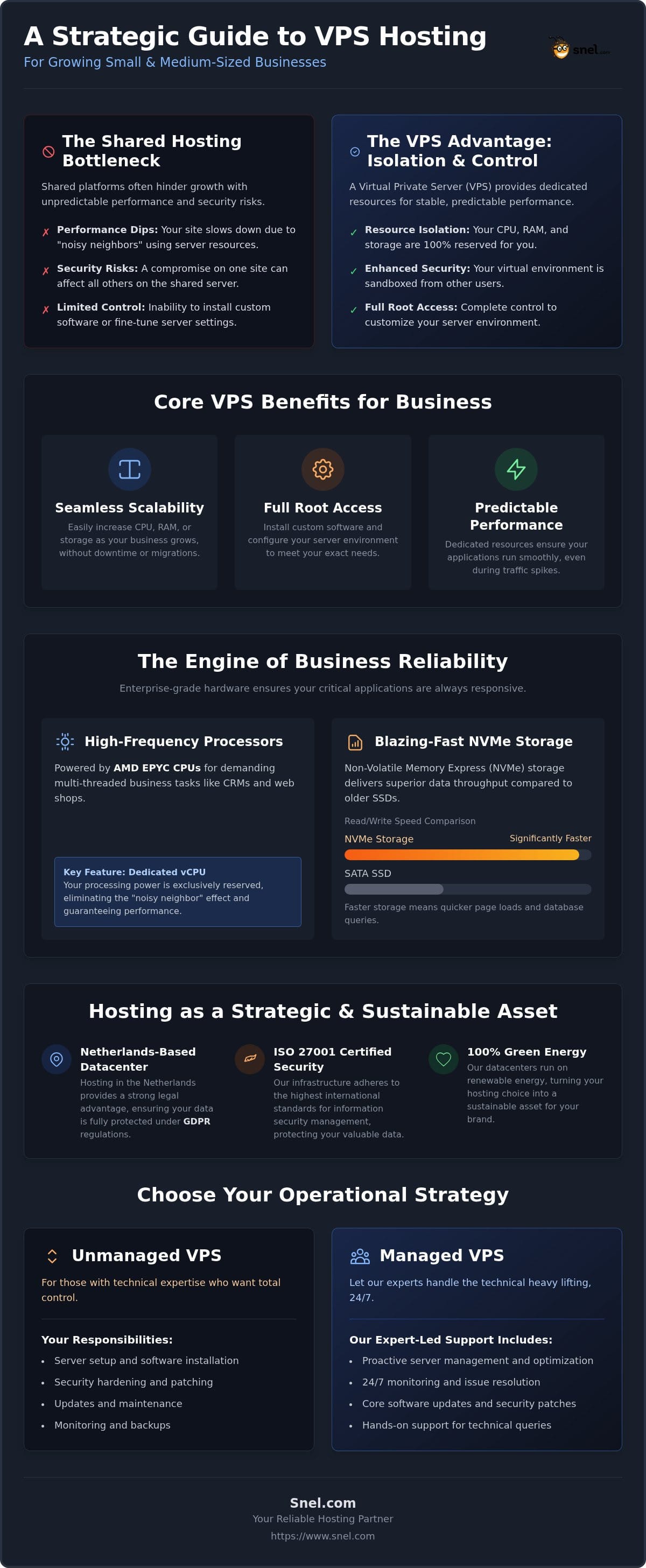
A Virtual Private Server (VPS) acts as the dedicated digital foundation your company needs to thrive. It functions by partitioning a powerful physical server into multiple isolated environments using a hypervisor. While you technically share the physical hardware, your resources like CPU, RAM, and NVMe storage are strictly reserved for your use only. This isolation is the primary reason why a vps for small business is a superior choice compared to entry-level hosting. Are you still sharing your business’s digital resources with thousands of unknown neighbors? If so, you’re likely feeling the constraints of a platform that wasn’t built for professional growth. You can learn about our VPS options to see how dedicated resources provide the stability your brand requires.
Why SMEs Outgrow Shared Hosting
Shared hosting is often a starting point, but it quickly becomes a bottleneck for growing teams. Performance dips frequently occur during peak business hours because another website on the same server is experiencing a traffic spike. This leads to slow page loads, which can result in lost revenue and customer frustration. Security is another major concern. On shared platforms, multiple accounts share the same operating system environment, increasing the risk of cross-site contamination if one neighbor is compromised. Additionally, limited customization prevents you from installing specific software or fine-tuning server settings for your unique operations.
The Core Benefits of Virtualization for Business
Virtualization offers the power of a dedicated environment with significantly more flexibility. Key advantages for a vps for small business include:
- Full Root Access: You have complete control over your server environment, allowing for custom security configurations and software installations.
- Seamless Scalability: Easily increase your RAM or vCPU as your user base grows without the need for hardware migrations or lengthy downtime.
- Predictable Performance: Dedicated resources ensure your applications run smoothly regardless of what other users on the physical host are doing.
By moving to a virtualized environment, you gain a scalable partner that grows alongside your business. It provides the reliability your customers expect while giving you the technical freedom to innovate.
Performance Hardware: The Engine of Business Reliability
The hardware driving your server is the invisible engine that determines if your business applications run smoothly or stutter during busy hours. For a vps for small business, reliability isn’t just a buzzword; it’s a direct result of the underlying components. We utilize AMD EPYC processors specifically to provide the high-frequency performance required for multi-threaded business tasks. This level of power ensures that your CRM, web shop, or custom app remains responsive even under heavy load. You can explore our Pure Performance VPS hardware specs to see the difference enterprise-grade components make.
The Role of Dedicated vCPU Allocation
A vCPU is a virtualized slice of a physical processor core that handles specific computational requests. In many low-cost hosting environments, these slices are overprovisioned, meaning you’re competing with others for the same processing power. Our Pure Performance VPS features dedicated vCPU allocation. This ensures your processing power is reserved exclusively for your operations, effectively eliminating the ‘noisy neighbor’ effect. Dedicated resources are essential for running intensive databases and high-traffic e-commerce platforms that cannot afford a millisecond of lag. If you’re unsure which configuration fits your traffic patterns, we’re happy to discuss your hardware needs.
NVMe Storage and Data Throughput
Data throughput is the second pillar of a reliable vps for small business. We use NVMe storage because it provides significantly higher read/write speeds compared to traditional SSDs. By removing the SATA interface bottleneck, NVMe reduces page load times and database query durations. This speed doesn’t just improve the user experience; it directly impacts your SEO rankings and visitor retention. Faster storage means your server spends less time waiting for data and more time serving your customers. This efficiency is a core part of our commitment to being a dedicated hosting partner that prioritizes your technical success.
Compliance and Sustainability: Hosting as a Strategic Asset
Your hosting provider acts as a legal anchor for your data. In an era where data privacy is a top priority, choosing a VPS for small business based in the European Union provides a significant strategic advantage. Specifically, production data hosted in our Rotterdam datacenter ensures full GDPR compliance. This setup protects your business from the jurisdictional overreach of the US Cloud Act, which can affect providers with American headquarters. We also maintain ISO 27001 certification, providing a verified framework for information security management and risk mitigation.
Just as we provide a legal anchor for your digital assets, those seeking to navigate physical waters with the same level of certified expertise can explore Theorieopleiding Belgisch Stuurbrevet to secure their official boating credentials.
GDPR and Data Residency in the Netherlands
Production servers in the Netherlands keep sensitive customer data within a jurisdiction that prioritizes privacy. This is a critical requirement for businesses in finance, healthcare, and professional services where data residency is mandatory. For added resilience, we utilize offsite backups in Frankfurt. These serve strictly as a disaster recovery layer while remaining within the European Union. By maintaining this infrastructure, we help you build a DDoS protected VPS Netherlands environment that is both compliant and resilient.
Green Hosting and Corporate Social Responsibility
Sustainability has become a differentiator for modern companies. Snel.com utilizes 100% green energy, which helps you reduce your digital carbon footprint without sacrificing performance. Efficiency is measured by Power Usage Effectiveness (PUE). Our datacenter maintains a PUE below 1.15. This value is significantly better than the industry average of 1.5, meaning less energy is wasted on cooling and overhead. Choosing an eco-friendly VPS for small business shows your customers that you value responsible growth.
Managed vs Unmanaged VPS: Choosing Your Operational Strategy
Deciding between managed and unmanaged hosting is the final step in securing your digital future. While technical users often prefer the total control of a self-managed server, many growing teams find that managing a professional virtual environment is like deciding between hiring a chauffeur or driving the growth ladder yourself. If you prefer to focus on your products rather than server logs, a managed approach offloads the technical burden to an involved partner who monitors your systems around the clock. For those who appreciate this level of professional support in their physical travels as well, you can check out Goedkope Taxi Nederland for reliable airport and long-distance transport.
When to Choose Managed Services
Businesses without a dedicated in-house System Administrator benefit from the security of expert-led maintenance. Managed servers include 24/7 monitoring and automated security patching to keep your applications running without interruption. We also integrate Acronis Cyber Protect to ensure data integrity through encrypted backups. This setup provides a safety net for SMEs, where technical specialists handle the background tasks while you focus on customer acquisition and software development.
Scaling Without Friction
A strategic hosting partner should offer modular scaling that allows you to increase RAM, vCPU, or storage independently. This ensures you aren’t forced into expensive upgrades for resources you don’t yet need. We prioritize your freedom by offering monthly cancellable plans, which prevents the vendor lock-in common with global cloud providers. By choosing a flexible plan, your infrastructure remains as agile as your business model, adapting instantly to new market demands.
Maintaining this agility often requires ensuring that every aspect of your operation, including your physical premises, is up to code. If you are overseeing property in the Netherlands, you can visit Schippers Bouwconsult BV to learn more about structural engineering and building inspections that support your business’s physical foundation.
Future-Proof Your Business Infrastructure
Transitioning to a professional hosting environment is a significant milestone for any growing company. You now understand how enterprise-grade hardware like AMD EPYC processors and NVMe storage create a stable foundation that shared hosting simply cannot match. By prioritizing 100% Dutch data residency and ISO 27001 certified security, you ensure your customers’ information remains protected under the strictest privacy standards. This strategic choice turns your hosting into a reliable asset rather than a technical burden.
Selecting a vps for small business is about more than just raw specs; it’s about finding a partner that offers the flexibility of monthly cancellable plans and the reassurance of 24/7 expert human support. Whether you choose to manage the server yourself or let our team handle the technical administration, your infrastructure is ready to scale as your vision expands. We’re here to help you navigate every technical hurdle with a personal touch that large, impersonal providers often lack.
We look forward to helping your business reach its full potential with a hosting solution built for longevity, performance, and reliability.
Frequently Asked Questions
Can I host multiple domain names on a single server?
Yes, virtualization allows you to host several independent websites or applications on one instance. By using a control panel like Plesk or DirectAdmin, you can manage different domains with isolated databases and mailboxes. This makes a vps for small business a cost-effective choice for companies running a main site alongside several landing pages or internal testing environments without paying for multiple separate accounts.
Does a Rotterdam-based server impact my global website speed?
While physical distance influences latency, the Netherlands houses the AMS-IX, one of the world’s most advanced internet exchanges. This connectivity ensures that your site remains highly responsive for users across Europe and North America. For a truly global audience, you can easily pair your local server with a Content Delivery Network (CDN) to cache static files closer to international visitors.
How long does it take to increase my server resources?
Most resource upgrades are processed in under 10 minutes. Unlike physical hardware migrations, virtual scaling typically requires only a quick reboot of the operating system to recognize the new RAM or vCPU allocation. This allows you to respond to unexpected marketing successes or seasonal traffic spikes without having to schedule lengthy maintenance windows that disrupt your operations.
Which control panels are best for non-technical business owners?
Plesk and DirectAdmin are the leading choices for simplifying server management. These interfaces provide a graphical dashboard for tasks that would otherwise require command-line knowledge, such as creating email accounts or installing SSL certificates. Choosing a managed plan often includes the license for these tools, which significantly reduces the technical barrier for your team while maintaining professional-grade control.
What specific security measures are included beyond basic firewalls?
Professional hosting includes advanced layers like IP Reputation filtering and Brute Force Protection. These systems automatically block traffic from known malicious sources before they even reach your application. When combined with our ISO 27001 certified protocols, these proactive measures significantly reduce the risk of successful cyberattacks compared to standard setups that only offer basic firewall rules.